<< XXIV Dieu est un fumeur de Havanes
To France. Buy a property! A farm in Provence! You only live once!
Rev. Van Oeckel teaches French at the Sint-Jozefscollege. He made a vow to become a priest if he survived the war. The Reverend is a bon vivant with a country house in Castellane, where he helps a farmer with money and drink problems to find a buyer for his estate. That is how Frie and his brother Jos end up in the capital of lavender.

Domaine Le Plantier, circa 1972
In 1963 Frie and Jos buy the building in the distance in the photo. A real postcard landscape. ‘Le plantier’ near old Digne, at the foot of the Alps. The region is known for its many fields full of lavender. Quite a few families from Aarschot and surroundings came on holiday there from the early 1960s until the 1990s.

the little boy at front left is Pieter, the blonde girl waving is Ilse, Frie with Gert

Mia (34) and the children enjoy the summer holiday.

the window of Pieter’s bedroom is open

Pieter

Gert, Frie, Pieter and Ilse (photo: 1973)
According to Frie, people who live in the South lead a double life. Langdorp he calls “the damp wood”.

But why does Victor Hugo begin his novel ‘Les Misérables’ in Digne?
The writer begins to take an interest in the bishop of Digne, François de Miollis, reputed to be good and generous, who will become his model for Monseigneur Myriel in the novel ‘Les Misérables’.

‘Blissful feeling’ Frie is a man who can only keep turning by continuing to turn. But perhaps he also does so because he is afraid that his machine will not start up again once it has been stopped? He takes his family to Digne for two months. He himself returns to the notary’s office after a few days of recharging his batteries. The previous owner of ‘Le plantier’ calls by regularly to catch pigeons from the pigeonnier (dovecote), whose necks he wrings on the spot.
Trailer of the 1973 film “L’affaire Dominici” shot in the area around Champtercier, starring Jean Gabin
Giono’s remarkable book, who attended the trial in Digne about the terrible and enigmatic Dominici case in which an English couple and their little daughter were murdered, is fresh in Mia’s memory. She is afraid in the remote country house in a region that is rough, hard and stingy with the fruits of its soil. The oppressive old farmer eyes the Limburg woman with great appetite. Sister-in-law Sidone urges her to wear a long dress instead of a monokini.

Pieter, Gert, shepherd Lydé and Ilse with the sheepdogs Fidèle, Toulouse, Panpan and the flock of sheep.

Shepherd Lydé is only too happy to see the people from Aarschot come. He is allowed to use the 63-hectare estate for his flock of sheep. Gratefully, the family is invited every year to a feast with home-grown produce. At the table Lydé does not use a table knife but takes out his pocket knife.

Shepherd Lydé and Gert. Lydé taught Pieter to drive the tractor.

Farmer Lydé met his death on his tractor, a Massez-Harris, Pony.
Between 1951 and 1961, 92,137 Ponys were built in France.
The Pony tractors were the first on French farms
from 1948 to 1950 under the Marshall Plan.
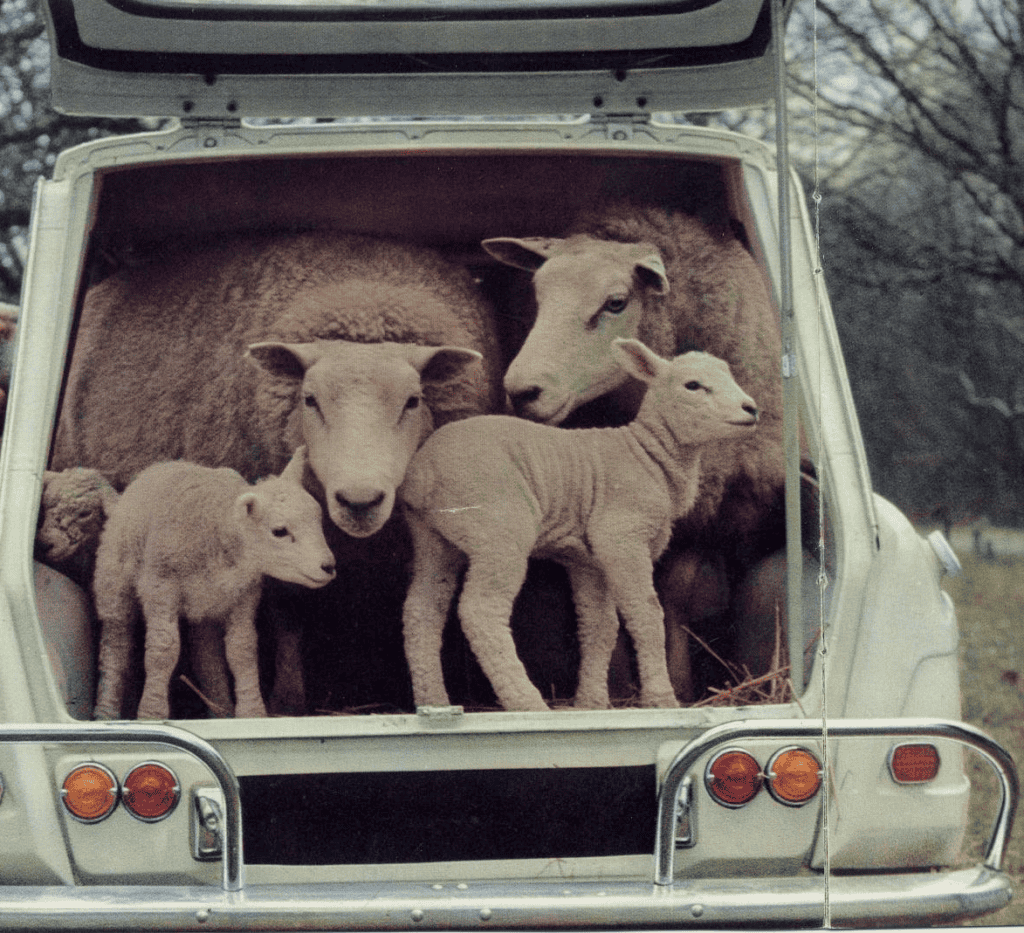
With a Citroën Ami 6, Lydé manoeuvres on stony mountain slopes

Ilse and Pieter

Mia in Champtercier

Ilse (photo: 1974)

The ruin of the birthplace of the freethinking astrologer Gassendi (1592-1655) is located on the estate ‘Le plantier’ in Champtercier. Gassendi had frequent contact with Galileo. Gassendi was the first to observe the transit of Mercury in 1631.

Carla Van Landuyt, the girl died and caused sadness in the circle of friends of Mia and Frie. (photo: 1974)

Gert, shepherdess Lydé, Ilse

Mia with the Pic d’Oise (1,140 m) in the background
“Whoever climbs the mountain can enjoy the view.” – Bart De Wever

Ilse and Frie

Ilse and Gert quarrel over the Italjet 50cc
Motorcyclist Frie, in a leather jacket with Pieter on the back, tearing along the Provençal road. It is an image inextricably linked to Frie on holiday. “In the morning father and I set off on an outing. The touring bike and father’s outfit resembled those of the ‘Franse zwaantjes’ (French swans), so that drivers slowed down. At midday we stopped at a good restaurant. The trip continued after a nap on a bench under a tree. Once home I got a revolver shooting lesson” – Pieter
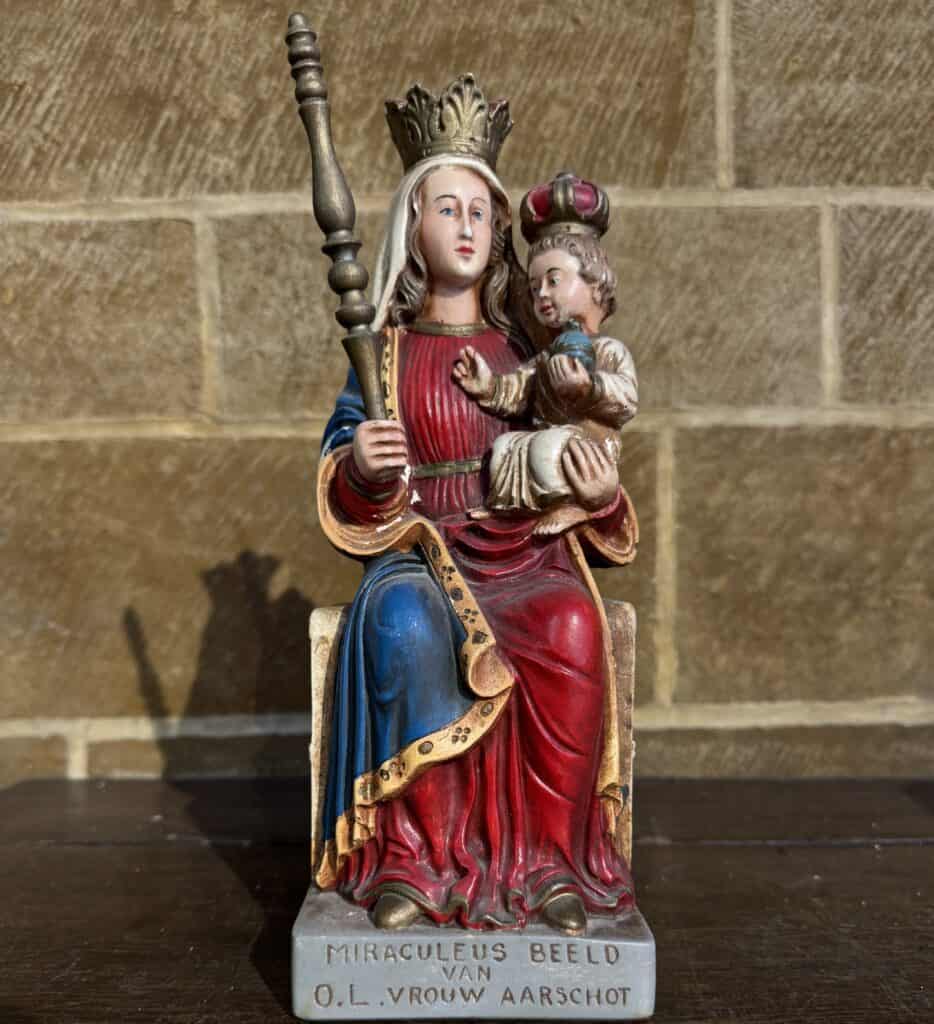
In the kitchen in Champtercier stands a miraculous statue like Our Lady of Aarschot.

Godfried (43) finds peace at his favourite holiday spot: Champtercier, in the Alpes de Haute Provence

Mia as Lavendula (photo: 1973)
A fairy named Lavendula was born on the Montagne de Lure in the Alpes-de-Haute-Provence, in the middle of a field full of lavender. She looked for a place where she could live and came across Provence. The fairy became terribly sad at the poor landscape where barely any green could be found and cried onto the page in the Atlas. Her tears made big stains, after which she took a piece of blue sky and stuck it onto the stains. Miraculously, since that day lavender has grown in Provence to make the nature-poor region more beautiful.

Gert, Pieter and Ilse

Frie takes his hunting rifle along to Champtercier, which stands there next to his bed, and a revolver with which he initiates his little sons into pistol shooting.

“Read a book or do something useful.” – strict Frie repeats in vain to his children
In 1979 Frie is put in plaster after a fall from his horse, whereupon Mia sells the horses, which Frie immediately replaces with motorbikes.

Frie with sister-in-law Sidone

Every year loved ones receive “sunny greetings” on lavender postcards. Is it the lavender fields that drive Pieter crazy about mauve? In any case, Godfried keeps a close eye on him to see that the cards are written “properly” and that the stamps are stuck on neatly straight.

“When you want to buy a property in Provence you must always make sure there is a spring” – Frie. The film adaptation of the book by Jean Jonot (1934-2023), an ecologist from Grenoble, is about an inheritance and the importance of a spring in Provence. Exactly as in Champtercier. Even the estate bears the same name “Le Plantier”. (1986) Mia takes her sons to the cinema for “Jean de Florette & Manon des sources”.

a last visit to shepherdess Lydé
“La lavande parfumait jusqu’aux étoiles l’eau qui l’imprégnait sur ses profondeurs naturelles” – Arthur Rimbaud

l. to r. Tineke Sas, Arie Sas, Ingrid Van Landuyt, Clairette Serneels, lawyer Willy Van Landuyt, Ilse V.K. (photo: 1974)
IN PROVENCE… MEMORIES OF THE SUMMERS OF THE 1970s AT CHAMPTERCIER… – by Tineke Sas
What I still remember well are the immense, sprawling fields of lavender with that heavy, specifically Provençal aroma and the wonderful summer sounds of crickets and swarms of bees.
In between, Margot Van Osta and I picked armfuls of lavender … bee stings? We did not know those yet back then… For hours we sat crouched between the bushes and loved displaying our bouquets later in all the glass jars we could find.
The swimming pool, or what passed for one then, filled with ice-cold spring water in which Mia taught me to swim in barely a quarter of an hour. She could be very persuasive, so that every doubt dissolved in the ice-cold water! No faster course than learning to swim in ice-cold water, because you had to do it before turning blue. The nice thing was that we were never alone in the water. It teemed with tadpoles, which we then went to observe at length every day… You never knew whether a prince might suddenly emerge from one…!?
That is what they had made us believe as 9-year-old girls, and we gladly believed it, at least back then…
It was also always very pleasant there; a cosy bustle with many families.
Somewhere in the old bastide a few old dusty rooms were still hidden away with rickety, creaking beds, probably from before the First World War. Mattresses with sturdy springs! During the siesta Margit and I would jump on them to our hearts’ content. The dust and feathers then flew all around…
Afterwards we got very hungry and set off on a search through the kitchen cupboards, where Mia’s homemade jam with big strawberries was a huge hit!
But while snacking our hearts pounded in our throats with excitement at not being caught…
We also made up all kinds of ghost stories and went to catch scorpions with a big glass jar. What did we know that those creatures were so dangerous…? Until Frie once explained it to us at length and in great detail, and that was immediately the last “scorpion hunt” of that summer.
Later, when I was 17, I organised a little dance with the small girls under the big tree for all the parents. It was to the song “Forever and ever” by Demis Roussos, the star of the 1970s.
Forever and ever… these nostalgic and fine memories of the summers “of back then” in Champtercier! – Tineke Sas (2024)
Is there a specific reason why Pieter keeps in touch with the Pansieri family from the town of the purple-blue flower?

Nicole Pansieri and her daughter Véronique, with whom Pieter spent youth holidays, visiting Pieter in Paris (photo: 2017)
Nicole Pansieri comes from a northern French family with ties to the noble de Ligne family. This grande dame is described as serious and cultivated. Her husband, Jules Pansieri, has ties to the Order of Malta. The traditional Pansieri stand for a life of influence and honour. The influence of the hostess on Pieter’s daily life goes beyond merely teaching him French. The noble lady insists that the elegant young Pieter has good manners, is honest and neat, well behaved and pleasant in conversation. Their Provençal home houses a library focusing on the visual arts of France in an international context. With pride Madame Pansieri shows Pieter the most unique books and instructs him with great patience in the various art movements. Notary Godfried and Mia welcome the French couple to the Steenheuvels in Wolfsdonk. Their youngest daughter Véronique is looking forward to discovering Belgium and will certainly spend summer holidays in Wolfsdonk.

” … M. Jules-Henri Pansieri existe pourtant et il n’a rien d’un passe-muraille. Ce pied-noir de Tunisie, âgé de quarante-neuf ans, bâti comme une armoire provençale, Dignois d’adoption depuis dix-huit ans, fait même partie des portes personnalités d’affaires, où il prospère en vendant des automobiles. On ne peut l’ignorer non plus dans le microcosme politique, puisqu’il fut l’un des premiers giscardiens du département des Alpes-de-Haute-Provence, où il fonda naguère la fédération des républicains indépendants. …” – Le Monde le 05 Mai 1988
“Mon Pieter, … Quelle émotion de voir ton reportage avec toutes ces belles photos de chacun d’entre vous. Je me posais la question de quelle âge nous avions quand nous nous sommes rencontrés. Certainement 13/14 ans. C’était hier… Que de belles rencontres et beaux souvenirs que nous avons partagés et qui nous ont forgés. Je me rappelle très bien de mes vacances chez vous à Knokke-le-Zoute ainsi que des sorties que tu faisais avec ma maman sur Sisteron pour voir les concerts classique des nuits de la citadelle ou le Salon des Antiquaires à Monte-Carlo. … Merci d’associer la famille Pansieri à ta rétrospecitve qui témoigne de nos liens d’amitié indestructibles. …” – Véronique Pansieri (2025)

(around 1984) Luc, the garage owner’s son, and Pieter are “camarades de jeux”. At the petrol station on the Route de Marseille they not only help customers fill up but also clean car windows. The station offers LPG refuelling facilities. As a result countless cars with caravans and Dutch number plates pull in. The little boys arrange and rearrange showroom models in the showroom until Luc smashes through the big display window with a Jeep Renegade. “Le garage de Haute Provence” has over fifty employees. In the garage workshop, the changing room and the toilets hang posters and calendars of naked women. Such photos are, incidentally, widespread in car and motorbike garages. (anno 2026) During a visit by Pieter to his dealer in Vincennes he wants to give an erotic women’s calendar as a gift, but the workshop manager warns Pieter that such a thing is boundary-crossing today.


XXVI Les Belges aiment la bagnole >>>