<< X Studies

Godfried campaigns for King Leopold III on the Grote Markt in Aarschot
In 1950 a young Godfried proves his Belgitude. He lines up squarely behind King Leopold III and is part of the campaign team for the first and only national referendum as a solution to the Royal Question.

That Godfried is interested in the army is not new. Arthur Van Kerckhoven had earlier let it be known that his son dreams of becoming an officer.

In 1956 Godfried follows officer training with the land component of defence

Leuven fair (1956)
« Inter arma silent leges » (Amid the force of arms, the laws fall silent)

Frie described his military service as the finest period of his life.

High-level encounters

Visit of King Baudouin and Queen Fabiola to Aarschot. Mayor Jos Pelgrims (from 1972 to 1976) and Frie are neighbours and live in the shadow of ’s Hertogenmolens. (photo: Grote Markt Aarschot, 1973)

‘s Hertogenmolens Aarschot -1911 – Lucien Rion (1875-1939) – oil on canvas

Postogram on the occasion of Frie’s retirement
25.8.1998 in Aarschot From a small Aarschot office you made one of the largest in the district. You were the prototype of the “very good” notary: – No professorial learning, but with knowledge of the matter, calm, discreet, often with a smile, sometimes with a sharp eye and above all with a remarkable simplicity… you have perfectly completed thousands of files. What a career!!! Your children may be proud of you. Congratulations Fried. – Jos and Christiane Pelgrims

Jos Pelgrims (1926-2021) en Mia (photo: Antwerp, 1968)

Godfried with Frans Janssens (photo: 2011)
Frans Janssens (1922-2018) was the unofficial village mayor of Wolfsdonk. Frans, who held several civil and military honours and chaired countless associations, involved Frie in the social life of Wolfsdonk. Frans Janssens appointed Frie honorary chairman of the brass band.

Godfried as honorary chairman of the Koninklijke Oudstrijdersbond Wolfsdonk-Langdorp commemorates the end of WWII

Mayor André Peeters regularly has a conversation with the notary. In this way Godfried stays informed about current town policy.
“Your father will always live on in my memory as a warm, modest and wise personality, who moreover was not without a special, dry form of humour. No wonder that with those qualities he was loved throughout our town! Wolfsdonk and its beloved brass band also carried him in their hearts. Personally, I always liked meeting him. I felt, after all, that our appreciation and respect for each other were mutual. I have met very many people in my life and my memory of many of them unfortunately fades with the years. The memory of your father, however, remains very much alive. That says a lot about his personality! As a son you may be proud of him! You too, by the way, I have always appreciated.” – André Peeters Honorary Mayor (2024)

Paul, Frie, Fred, Jos. Fred stayed with the Van Kerckhoven family as an English soldier during the liberation.

Jos en Fred
In 1982 and 1983 father obliges us to follow the episodes of the BRT television series about the Second World War ‘De Nieuwe orde’ by Maurice de Wilde (1923-1998). When ‘the führer from Bouillon’ Léon Degrelle (1906-1994), who founded the Belgian fascist movement Rex, appears on screen, I see the horror and fear in my father’s eyes. For the rest, I never knew my father to be fearful.
In the mid-1970s Luc Delafortrie (1912-1999) becomes a well-known neighbour. He was an organiser of the Verdinaso, editor of De Standaard, publicist for De Nieuwe Gids, writer, poet. The author urges Frie not to parcel out his woods, otherwise he will file a complaint on suspicion of extortion and professional discrimination. At Christmas Frie receives a four-metre-high Christmas tree and a volume of poetry by Delafortrie. In 1983 he is interviewed in his wood for the TV programme about WWII ‘De nieuwe orde’ by Maurice Dewilde. The neighbour’s success also has a less successful face (and I do not even mean the collaboration). The co-founder of the Priester Daensfonds moves away and leaves Frie bewildered when he has nevertheless converted his woodland into building plots, which he sells.
« In quite a lot of people the word precedes the thought. ” – quote Luc Delafortrie

Mia and Ilse play a quatre mains. The lady half in view in the brown evening dress is Cileke, the wife of minister Jos Chabert.

aunt Cileke (1935-2020)

Minister of State François-Xavier de Donnea, Minister of State Jos Chabert (1933-2014), Mia (photo: 1998)
“Les grands noms sont toujours de grandes raisons aux petits génies.” – Cardinal de Retz Les hommes ne croient jamais les autres capables de ce qu’ils ne le sont pas eux mêmes. Un homme qui ne se fie pas à soi-même ne se fie véritablement à personne.
“I can go every day. I am invited everywhere. I would much rather have stayed at home.” – Mia
Pieter has to address the minister and his wife as uncle Jos and aunt Cileke because “That may come in handy later.” To stay in good shape for a long time, this uncle Jos eats an apple every day. In the seventies he and his wife are frequent guests at the Steenheuvels. Usually Chabert drives himself in his black ministerial Mercedes with a giant antenna on the boot. ” On Sunday afternoons too the couple come walking in the Langdorp woods. Cileke is particularly kind and concerned about Pieter. Often the two walk some ten metres behind the group and she talks softly to him about ‘relations humaines’. Once Cileke stays away. Her husband, the minister, ran off and conveniently had his Cileke tucked away in a psychiatric institution. Pieter is left with a lifelong aversion to machismo.
“Only a morality that anchors itself in an appeal from the other, from the world – and for believers from God – can offer a firmly founded frame of reference.” – Johan Van der Vloet
Chabert succeeded in pushing through a number of unpopular but necessary measures, such as compulsory seat belts, speed limits and stricter alcohol checks.

High-level visit to Wolfsdonk: Prime Minister Mark Eyskens, the first Belgian in space Dirk Frimout in 1992, the noble families von Strydonck de Burkel and de Spoelberch are guests.

Mia, professor Roger Blanpain (1932-2016), Pieter, neighbour Clairette Serneels (1936-2024) (photo: 2001)
Blanpain makes the world press by declaring that the pope is punishable under Belgian law because women may not become priests. In 1991 he proposes abolishing the Salic law, so that women in our country too could sit on the throne. King Baudouin accepts the proposal.

His Excellency Gunnar Riebs, Prince Charles Count of Flanders (1903-1983) was the brother of King Leopold III and Rev. Jos Goor (photo: Aarschot, 1979)
The following text by His Excellency Gunnar Riebs.
I accompanied the late Rev. Jos Goor when he carried communion. At first we went on foot. Later by car and Notary Van Kerckhoven was the driver. It was a solemn moment every time.
“You are a priest for ever”, says the psalmist. Something of that eternity always hung about Mijnheer Goor, as he was commonly addressed.
For communion of the sick Mijnheer Goor wore a priest’s cassock – which he incidentally wore daily throughout his life – and further surplice, stole, humeral veil and biretta. Under the humeral veil the Blessed Sacrament, kept in a pyx.
The priest sat next to the notary, I at the back with the corporal in a burse and ready to open the car door.
In the houses where we brought communion, the table was like an altar: a beautiful tablecloth, a crucifix with two burning candles.
Further two cups, a first with holy water with a palm branch. “Lord, bless this house and all its inhabitants” – so the priest began – and blessed with holy water.
The other cup with ordinary water for the ablution, after the distribution of communion.
On a dish lay a couple of fine cigars for Mijnheer Goor and – to my great joy – a coin for me.
Notary Van Kerckhoven had a list with the addresses, because out of reverence for the presence of God himself in the Blessed Sacrament, the whole journey took place in silence. I do realise that – when one reads this today – it is a story from another century, literally and figuratively.
Gunnar Riebs, Consul General (H) of the Slovak Republic.

Rev. Norbert Jozef Goor by the hand of Leen van de Plas (34x34cm)
Regularly Mijnheer Goor comes to check on the notary’s office and Frie’s family. The notary invariably hands the Reverend bon vivant a wooden ‘Corps-Diplomatique’ cigar box.


From the sunny town garden of Mrs Riebs, with whom Mia has a chat every time she walks to the town centre: the ‘Arthur Bell’ rose. Godfried’s favourite flower. Symbol of strength, togetherness and cheerfulness.

The death of Baudouin, his king, is for Godfried “a moment of sorrow”. King Baudouin was three weeks younger than Godfried and died at the age of 62.
“ Everyone carries some suffering with them somewhere. Even people who have known great success hide great suffering. Complexes, wounds. Once you have understood that, you realise that we are all only human. That brings people closer together, and then you can understand them better. ” – King Baudouin

Godfried, Mia, *Colonel and Mrs Gustaaf Rens, Mayor and Mrs Willy Schellens, Gilbert and Mrs Rens, Carine Rens
* veteran Colonel pilot Gustave Rens (1917-2013) During the Second World War he committed himself actively. Thus the colonel pilot managed to escape from Belgium by leading, at risk of his life, the 1st Guides (Jagers te Paard) through the enemy lines.
“Pieter, out of respect your father takes off his hat, he lifts it briefly when passing in the street. I am impressed by that. This gesture has disappeared from the streetscape.” – mayor Willy Schellens (1943-2021)
“Pieter, my father was very fond of you.” – Geert Schellens (1968-2022)

Frie thinks he can determine for Pieter what is important or essential. Pieter belongs to one of the last military conscripts. At the Recruitment and Selection Centre, popularly called ‘the little castle’ (after the shape of the building), he says he is a passionate motorcyclist. Pieter is called up as a motorcyclist to the unit ‘Ardennes Chasseurs’ in Vielsalm, whose motto is: “Résiste et mord”. For headstrong Mia far too macho blokes there in Vielsalm, and a political connection gets Pieterke ordered transferred to the Heverlee Barracks. A recruit from Heverlee will end up in the ‘Chasseurs Ardennais’ corps instead of Pieter. Frie makes a futile attempt to make Pieter a Reserve Officer. Pieter follows a French-language training as truck and Jeep instructor but is afterwards no longer inclined to dance to his superiors’ tune. After a strict upbringing his hunger for skin, noise and hosanna is too great. To the psychiatrist of the Military Hospital he whines about fear of men in uniform, he intends to throw himself off the Vilvoorde viaduct. From then on he only has to go to the barracks a few days a month. Once he drives home in the Bombardier Jeep with a few soldiers. At home at the entrance gate a soldier explains to the concierge: “The Court Martial is prosecuting Van Kerckhoven for desertion.” Beaming housekeeper to Mia: “You see, madam. I told everybody. That can’t last. With that Pieter, with what he gets up to.” Deathly pale, Mia goes hesitantly to the army Jeep to hear the charge. What hilarity when Mia sees through the farce! She invites Pieter and his fellow soldiers for a hearty bite and a glass of wine. For the rest of his military service Pieterke draws double pay as a mentally ill person, goes to work as a sleeping-car attendant at Wagons-Lits. And as if that were not enough, at weekends he plunges into the Brussels gay nightlife wearing Frie’s officer’s uniform. “You are a real shirker (carroteur: soldat qui se dérobe par un subterfuge au règlement, aux obligations du service). I had asked the Lieutenant-Colonel to keep an eye on you. And when I phone him he says you are never there, that he doesn’t know where you are. I am so embarrassed.” – Frie
«Pour maintenir un peuple dans l’obéissance inventez-lui un ennemi.» – Nicolas Machiavel
In 1999 Pieter ends up on an election list but then in “the most humble place”: as list-pusher.

Pieter’s campaign team: Jef antiek and Chris Goethuys


Jef antiek campaigns for Pieter

edited election poster of Pieter (photo: 1999)

At a VLD congress Pieter asks Prime Minister Guy Verhofstadt “For or against, when will gay marriage be possible”. The Prime Minister promises to work on it. A next question reads: “Why, as for women, there are no parity rules for gays on candidate lists”. When in 2003 marriage between two persons of the same sex becomes legal, Pieter and his ex-boyfriend Wim end up on the roof of the Minister’s office for this photo. Minister Rik Daems asks Pieter to defend the desire for children of homosexuals before the press. Pieter does not go along with that because he is of the opinion that you can wish for a child, but that it is not a right. He does not understand why so many homosexuals want to take part in bourgeois life instead of enjoying the freedom gained.


Discover the flower man
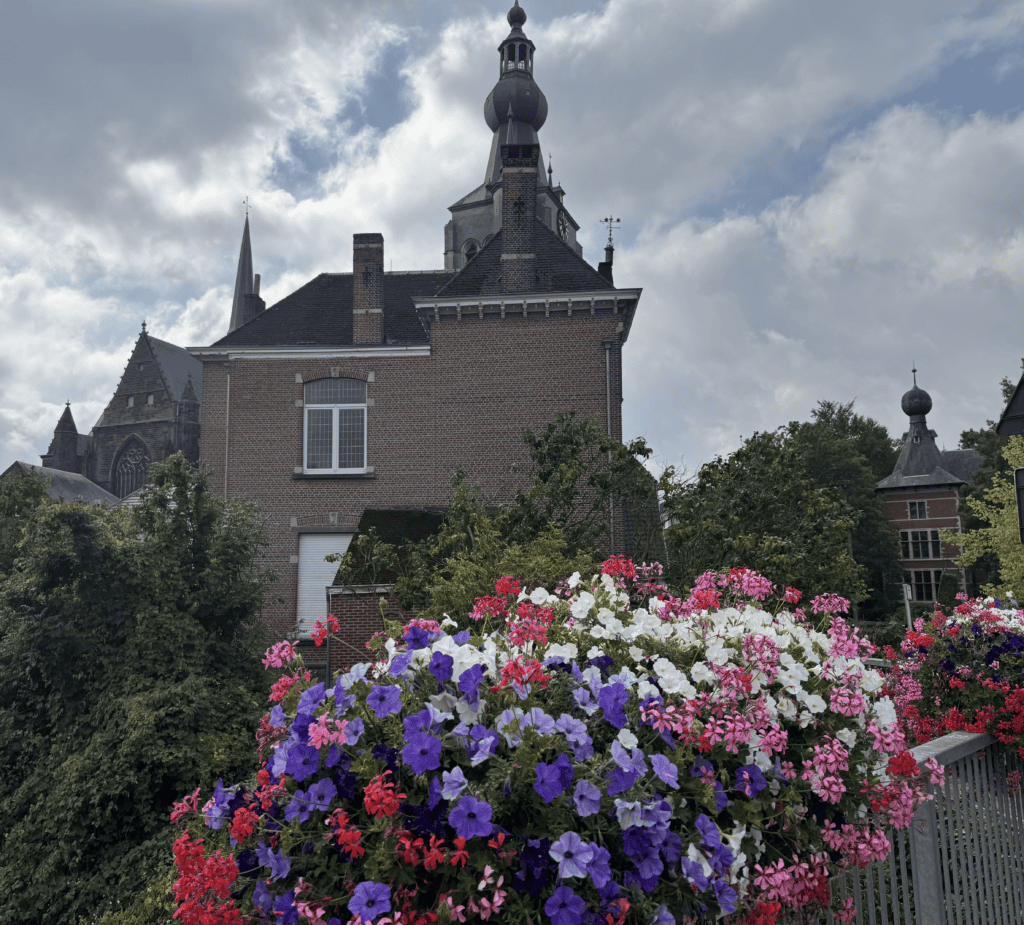
(2001) The chance that in Aarschot you will come across a flower box devised by Pieter Van Kerckhoven is great. Very great. In his search for local artists Pieter dives into the weekly De Klok, published in Aarschot from 1892 to 1941. In this important historical source for the region he reads a contribution about “Aarschot in bloom”. A remarkable association whose members communicate with tips, the exchange of seeds and plants, and encourage residents of the town centre to put flowers on facades and front gardens. A suitable moment for councillor Pieter Van Kerckhoven to make it an agenda item at the town council. He refers to the popular association of the early twentieth century and states that we must make flowers one of the main ingredients of the Pearl of the Hageland. That is possible for the future if all political noses point in the same direction. Within the council there is immediate uniformity. Mayor Schellens lets it be known that this marks the beginning of squares and bridges decked with flowers. “Aarschot residents who remember the start of this project still address me with praise. But when I explain my flower initiative to people who do not know its origin, I see them thinking: ‘What is he making up now.’” – Pieter (photo: Neerbrug 2026)

“Protect me from my political friends, with my enemies I will keep myself busy.” – Kamiel Huysmans

with minister Patricia Ceysens on the farm (photo: 2003)

with Gwendolyn Rutten on the flyer (photo: 2003)

with the Sheriff (1945-2009) at the fair

with Nicole Van Emelen, the queen of hearts of equal opportunities and the fight against poverty. Nicole, born in Aarschot, is a prominent figure in Aarschot’s political world. She is the first Aarschot woman ever elected to help lead the pearl of the Hageland. (photo: 2012)

grandfather clock – Henry Dille – Aerschot 1816
The in-laws of Nicole Van Emelen lived for many generations at ’t Zavelhof in Langdorp. In the fairytale setting where Frie reigns, this grandfather clock from ’t Zavelhof ticks.
« Horas non numero nisi serenas »
« I count only the happy hours »

Colonel Rens (1917-2013) and Mia

photographed with Princess Delphine von Sachsen Coburg
“Become who you are” – King Philippe
XII Rank and station>>>