XV Trop aimée

Clément Jamar (52) beams as never before with his wife Colette Swerts (52) at his side at the wedding of Godfried and Mia (photo: Bokrijk 1962)

Henri Swerts (1888-1979), the strapping bonpapa. Discover his story here.
Colette Swerts, the mother-in-law of Godfried Van Kerckhoven, came from the North Limburg municipality of Heppen, later a sub-municipality of present-day Leopoldsburg. Her father Henri was born on 17 November 1888 in Koersel, the son of Petrus Swerts (1850-1891) and Maria Vanherle (1848-1934).

With the help of a dog cart, Henri Swerts sells to the soldiers of ‘t Kamp.
The handsome hunk starts his career as a notorious cage fighter in Liège. The Swertses are knife-fighters, brawlers. Henri can hardly write but counting is his strength. With his dog cart he travels around Leopoldsburg and sells steadily to the soldiers of ‘t Kamp. At the time of the big manoeuvres up to 140,000 men bivouac in ‘Bourg-Léopold’. As a soldier he is selected because of his stature to be part of the Royal Palace Guard in Brussels. Because of the monotony at the palace Henri decides to catch forty winks. Palace guard Henri takes off his bearskin cap and lies down in ‘un fauteuil royal doré feuille d’or’ but is caught by little Princess Marie-José, who snaps at him. During the First World War Henri is called up to fight but he hides. He knocks together a wooden chest, shoves it under the hay, and crawls into it when they come looking for him. That way he can keep working.
Not step by step, but everything at once:
One of young Henri’s boldest schemes takes place along the *Beverlo Canal. There he toils as an unloader of inland barges. Henri unloads 70 kg sacks of coal and grain from canal boats. Between that canal and his home he sees trains with wagons full of coal coming from Antwerp slow down, to stop a little further on at ‘t Kamp station. Our cunning fellow strikes a deal with an engine driver to have the trains stop briefly right in front of his farm. Henri, waiting for the trains, quickly pulls a wagon open and lets the ‘black gold’ thunder out. Tree branches, hay and leaves are ready to quickly cover the pile of coal. In this way he transforms his farm and its surroundings into an unmissable trade in coal, seed and grain on the Beverlo Canal. Years later in the magazine ‘Ons Bestaan’: “The time when skipper Vanherck-Possemiers brought 250 tonnes of coal to Leopoldsburg for the merchant Henri Swerts remains a lasting memory.” – “Ons bestaan, Leopoldburg families”
*The canal was extended to Leopoldsburg at the time to supply the cavalry there. The canal is still open and ends there. In the ‘basin’ of the canal, close to where his trade was located, there is now a marina.
Tout est bon dans l’cochon

Bourg-Léopold – Camp de Béverlo – le ballon captif – the balloon Leopoldsburg zeppelin (1918)
Swerts makes a big announcement: “I get the food leftovers from the military barracks and am having a pig farm built. The blighters will gobble up all the leftovers.” Colette laughs: “Then we saw a zeppelin fly past. Nobody had ever seen anything like it. People came out and shouted: ‘There’s a great big pig hanging in the air!'”
Read the main developments about the farm of Henri Swerts

(around 1920) At the annual horse market in Sint-Truiden Henri Swerts each time buys some fifty discarded horses from the military cavalry. Once home the horses often fall over from weakness. “The horses are put between a row of straw bales so that they do not fall over.” Henri tends and heals the horses and lets them run in the meadows. When they are strong and healthy again he sells them on.
Marriage of Henri Swerts to Berthilia Maes (1909)

The Church of Our Lady of the Assumption is the parish church of Leopoldsburg.

Henricus and Berthilia Swerts Maes (photo: 1909)
The marriage of Henri to Berthilia comes as a total surprise. Soon after, following a ‘secret’ pregnancy, Berthilia and Henri welcome their first child. The girl, named Colette, is the first of six children.

top: Theresia Swerts (1883-1917) – Guillaume Maes (…-1942) – Remy Swerts (1875-1957) – Frans Swerts (*brawler) (1877-1971) – Pierke Put (1881-?) Louis Swerts (uncle of the farm)
bottom: …. – Berthelia Maes (1890-1942) – Henri Swerts – Josephine Van Herle (1848-1934)
*What does Frans Swerts do after an exchange of words between him and an unjust opponent of his family? Take the pitchfork in his hands and run the opponent through with it.
The forgotten Leopoldsburg woman Colette Swerts: “Her life reads like a fairy tale.”

young Colette at home, with the railway in the background
To teach her to swim, Henri throws his daughter Colette into the canal several times and, with a tow rope tied under her arms, hauls her through the cold water. Because of his harsh approach, Colette has a shivering fear of water for the rest of her life.
Henri is in a tizzy about his eldest daughter Colette: what is going on?

The Carmelite convent of Leopoldsburg (photo: 2025)
(1922) Father Edward Poppe leaves his working-class parish of Sint-Coletta in Ghent to found the Carmelite convent in Leopoldsburg.

the convent door in Leopoldsburg (photo: 2025)
As a young girl Colette often pulls this doorbell. A few times a week she hands in a basket of food here for the Carmelite nuns. During the conversations with the cloistered sister the little grille in the door stands between them. Colette lends her ear to Father Poppe (1994-1924). The man, canonised in 1999, convinces Colette to live as a woman consecrated to God, in seclusion from the world. Father Henri is thunderstruck when he learns of this plan and threatens to hang his pious daughter. Henri nevertheless keeps supplying free coal to the convent. Colette puts away her plan of the ‘little cloistered sisters’ (as she calls the Carmelites) and then arranges instead to stay living in seclusion at the parental farm with her eldest brother Louis and not to marry. This plan too is blown apart when the dutiful and deeply devout Colette in 1938, like a bolt from the blue, introduces her completely unknown partner Clément Jamar.
Discover the magical farm ‘Immert’

In 1901 the parental farm ‘Immert’ of Colette was built

calling card
Colette cycles around the whole area visiting churches, chapels and convents where she knows all the ‘little sisters’ and ‘little priests’. Every year she goes on pilgrimage towards Scherpenheuvel and Diest to the ‘holy little father’. Colette prays daily for ‘Our Dear Lord’ and ‘Our Lady’. Weekly she goes to mass but also to the cinema in Hasselt. Deeply Christian Colette abhors loose morals. Because of the enormous military presence there are quite a few brothels in Leopoldsburg: she calls them kabardoesjkes.
This is a real Colette classic

Colette has found access to the officers’ mess . There she secretly takes food from the kitchen that she passes on to help the poor. Until she is finally caught. Colette is not punished because she sympathises with ‘the poor little people’.

Colette Swerts (1910-2002)
Brothers and sisters of Colette

neatly dressed Louis and on the pony; curly-headed Guillaume

Guillaume Swerts (1924-2020), named after his godfather and war martyr Guillaume Maes.

Maria Swerts (1913-1996)
Josephina Swerts (….-….)
René Swerts (1932)

Louis Swerts (1915-1996) “Louis was supple and strong. He took a run-up and jumped on the horse from behind. Without a saddle he galloped through the meadow.” – Colette

(2026) Surprise in Leopoldsburg: twenty-four years after the death of Colette, her portrait as a young girl, standing next to the farm ‘Immert’. charcoal on paper – by Dirk Sevenants – exhibition – Zolder – Luchtfabriek ZLDR
Colette herself always dreamed of writing a book. During her lifetime that never happened, but now this little work of art is a tribute to her.

Dirk Sevenants lives on and owns the farm ‘Immert’ of the Swertses. The young programmer in the steel industry is also a technical draughtsman. He is perfecting his skills at the Academy of Fine Arts in Zolder. Dirk is passionate about the past of his house in the Asbeekstraat.

The drawing ‘Colette Swerts’ is on display in Zolder – De Luchtfabriek – 2026

view behind the farm ‘Immert’ (photo: 2025)

During the Second World War the flight route from England to Germany of Lancaster bombers of the Royal Air Force lies above the farm ‘Immert’ of the Swertses. Behind the meadow the German army has set up an anti-aircraft gun. During the night of 12 May 1944, British bombing raids accidentally hit the garden estate in Beverlo a little further away.

Eighty civilians of Beverlo lose their lives. The Australian pilot John Balmer also dies when his plane is shot down. “Pilots thought they were attacking a German camp. A mistake with a leaden toll.”
A broken heart, does it really exist?

“Mother died of grief when she learned that her brother Guillaume Maes had been killed in the Second World War.” – Colette

Berthilia Swerts Maes (1890-1942)
(1942) Particularly tragic: after the loss of her beloved brother Guillaume Maes ‘her heart is broken’. It is an illness that affects people who are otherwise often healthy.
‘Broken heart syndrome’ is a (rare) form of acute heart failure caused by a reduction in the pumping function of the heart. The syndrome occurs more often in women, especially after the menopause. But it also occurs in people with psychological stress or trauma, for example through the loss of a loved one.
(2024) René Swerts, 93, talks about the great emptiness when his uncle and mother leave the family behind.

lace work detail, by the hand of Berthilia Swerts Maes, Mia’s godmother
How is life to go on in Leopoldsburg after the death of Berthilia Swerts?
Widower Henri Swerts decides to stop working at once. Before his 50th year he has amassed five properties with land. Henri leaves his coal and grain trade to his son Louis. In 1943 he remarries, to Elisa Duchêne.
Who is the madammeke, Parisian widow of a French soldier?

Elisa Duchêne
“Les traditions comme les femmes sont faites pour être à la fois respectées et bousculées” – Jean d’Ormesson, homme de lettres et académicien français

(1940) The first husband of Elisa Duchêne: the French soldier Deman. He had dropped dead on the spot in Paris at the sight of the German occupier marching in.

On the roof of the bus, in a dark suit, you see Henri. Elisa is the first woman on the left in front of the bus.

Up in the air! Henri and Louis Swerts
The life of the couple Henri and Elisa consists of holidays and travel. For people of our time a perfectly normal thing. About 100 years ago holidays were out of reach for many people. Days off and holiday pay did (almost) not exist. From ‘madammeke’ (as Elisa is called behind her back) Henri learns that he should wear a three-piece suit and use ‘un bâton de marche avec un pommeau en émaux’ (a walking stick).

Henri Swerts and his second wife Elisa Duchêne
Mia about her step-grandmother (2025)
Anecdote about Mia by René, everybody’s friend (93 years old). He is the youngest son of Henri Swerts: “Mieke came to her grandparents on leave. In winter I had the meadow at the farm ‘Immert’ flooded so we could skate. I pushed the sled too hard with Mariake=Mieke=Mia on it. Mieke ended up in the barbed wire. She was laughed at by her cousin Odilia. But secretly, the little devil Mieke hit Odilia right in the face with great spirit. (2026)

Henri’s newspaper rack

Henri and Elisa Swerts Duchêne
“My mother was afraid of her stepmother, a Parisienne, and feared that I would turn the place upside down there. That is why, before we visited her, I got a preventive hiding in the street. Elisa could not cope with children, who had to sit still and keep quiet. Then I would fall asleep on a chair out of misery.” – Mia

Herman Swerts in front of the Citroën DS 21 of his father Louis. (photo: 1970 Houthalen)
“Our oldest known ancestor is a certain Blasius Swerts, who was recorded around 1672 as a locksmith.” – Herman Swerts
(2025) Herman pauses for a childhood memory “My mama Julia Volders (1916-1968) had died of a cerebral infarction and I was only 15 I think… . I still miss her every day. Your mama came to fetch me for a holiday in Duinbergen. So kind. It was fun. I had never been away on my own for so long. Posh big apartment. We went to the tennis court every day because there were a lot of pine trees there and I missed those. Every day I also went to the posh shops and galleries on the seafront of Knokke. I spent far too much money but it was still very nice. Your mama was already an angel then. In the back of the Porsche there was little room for my legs. ‘All right, Hermanneke? You can put your legs behind your neck… ‘ Such beautiful memories.” – Herman Swerts to Pieter


Henri Swerts with his granddaughter Mia Jamar
Colette and Clément got to know each other dancing to ‘Violetta’

“As a corsage on the left lapel of a blazer, the men wore a ‘Wijnknoppeke’ (Calycanthus) to look festive at a ball.” – Colette
“A force de sacrifier l’essentiel pour l’urgent, on finit par oublier l’urgence de l’essentiel.” – Edgar Morin (1921-2026)

Clément Jamar (1910-1969)
In search of the roots of Godfried Van Kerckhoven’s father-in-law: Great-grandfather Jamar was quartered as a Liège officer in the military camp of Leopoldsburg. Grandfather Theofiel Jamar was a joiner in Koersel.

The pocket watch of Theofiel Jamar
“Il vient une heure où protester ne suffit plus: après la philosophie, il faut l’action” – Victor Hugo

Clément and Colette Jamar Swerts (photo: 1938)

(1938) Clément Jamar and Colette Swerts marry in the church of Heppen. Clément works in the coal mine of Houthalen. In 1940 the couple have a daughter, Mia Jamar.

Cornflowers in a basket – by the hand of Pauline Jamar (1850-1911) – oil on canvas (38×46 cm) – Colette’s chosen flower

menu on the occasion of the wedding of Clément and Colette

(1940) Alone (her husband has been called up) with her little daughter in a pram, Colette takes flight and reaches Arras in France on foot. And that just after recovering from a surgical procedure. Courage and trust, prayer and love, supported by a cheerful, stubbornly persevering character, help her overcome all difficulties.

This clock ticks at the home of Clément Jamar’s parents
“Le temps s’en va, le temps s’en va, madame. Le temps, non, mais nous nous en allons.” – Pierre de Ronsard
Never heard of Hootelle (Houthalen)?

The village lies on the Campine low plateau and is first mentioned in 1117 as Hallu. Sources explain that the municipality’s name has to do with halahdra (juniper bush) and lo (wood), or else derives from Halen (hal = hard, dry ground) by the wood.

Nothing wrong with a good copy: looking inside the Limburg house of Clément and Colette

Ringlaan, 17 Houthalen – Colette stands at the window
Their house is a copy of a house in Hamburg-Poppenbüttel, built in 1937 by the architect Rudolf Lodders. The projection on the right is added to the drawing by Colette herself: “That way it looks more fairy-tale like”. “Allen seinen Wohnhäusern gemeinsam sind die geneigten, zum Teil gewalmten Dächer, mit Ziegeln, aber auch mit Reet gedeckt. Fenster mit Rundbögen und kleinteilige Fensterscheiben und Fensterläden bestimmen ihre Architektur. … Dort die zwar nicht weniger funktionalen, aber dennoch auf Rückzug, Privatheit und beruhigendes Wohlbefinden abzielende Raumatmospäre seiner Wohnhäuser.” – source: Der Architekt als Bauherr, Hamburger Baumeister und ihr Wohnhaus

Colette sees this house in a book and has roughly the same one built
In 1949 Colette and Clément build their picturesque and peaceful-looking nest, a small white brick villa. Before the foundations begin, Colette places a Our Lady medal on her building plot. In the garden along the sunlit orchard next to the village, hollyhocks and lilacs wave in the first summer breeze against a backdrop of den Teut: the largest heathland of Central Limburg, with a picturesque variety of stream valleys, pools, dunes, woods and little fields.

The Swartz family come from Vienna in an Opel Manta to visit Colette (photo: 1977)

Frie about Mia’s parental home: “That’s worth nothing. It was built right after the war. There’s no insulation in it. She won’t get anything for it and it will be razed to the ground straight away.” Towards the end Colette sells her house and obtains the price she had hoped for.

(2025) Still not demolished but the surrounding villas are. “Bomma hoped that I would go and live in her little house”. – Pieter

East, west, home is best

Clément and Mia

In a small room upstairs Colette hoards large supplies such as this soap ‘La Congolaise’. She is thinking of the First and Second World Wars. Shortages arose very quickly then.

Clément, Mia and Colette
audio story about Clément Jamar (recording: 2024)

The Art Deco stained glass of the Sint Martinuskerk in Houthalen where Clément and Colette go to mass.

Frie, Clément, Mia, Colette

“In this ‘Voltaire’ armchair Clément reads ‘Le comte de Monte-Cristo’ by Alexandre Dumas. It originally stood in Clément’s parental home in Koersel.” (photo: Hamburg, 2025)

2024, film adaptation of the novel by Alexandre Dumas
“Your own back is what the far side of the moon is to the earth. Always there and always invisible.” – Ludwig Volbeda
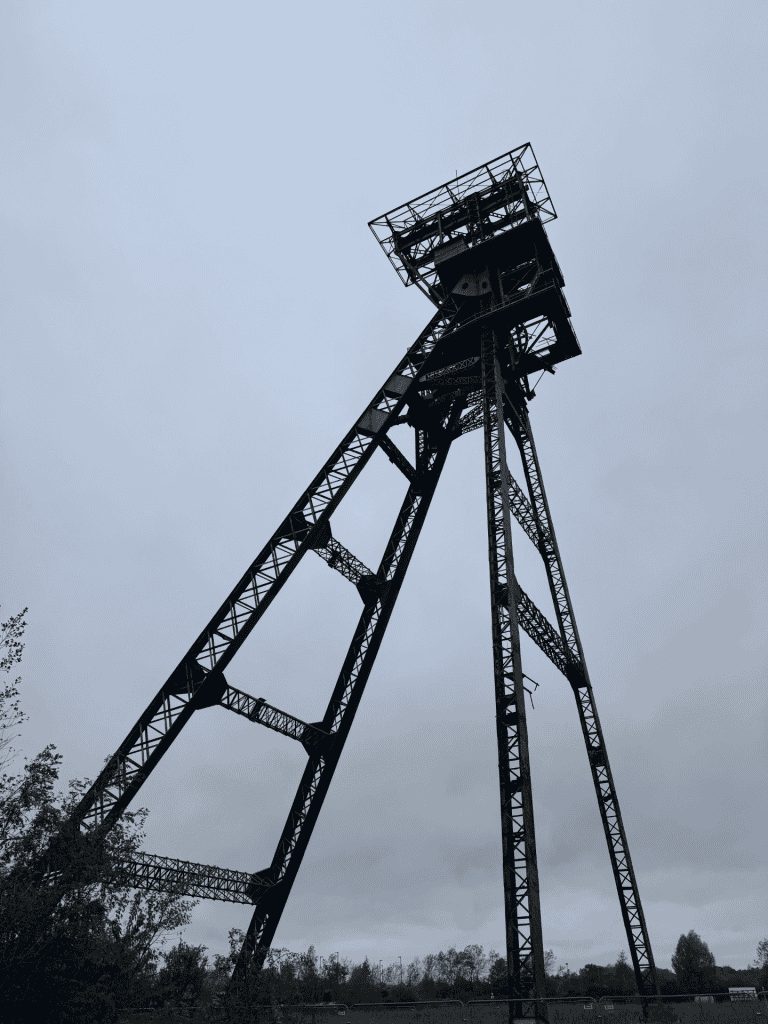
In 1939 71-metre-high steel headframes were brought into use in Houthalen. (photo: 2026)
Where coal was once extracted from the ground in Houthalen and thousands of miners worked underground in harsh conditions, today various kinds of entrepreneurs, start-ups, scale-ups and established companies active in growth, innovation, technology and transition science are at work at Greenville.

The main building of the Houthalen mine was erected in the 1930s in a monumental, functional style with an Art Deco interior. Today it serves as the innovation and business centre ‘Greenville’. There is also a museum with material from the mining period. (photo: 2026)
(2024) René Swerts talks about his brother-in-law Clément Jamar
Happiness can simply end: so do not tempt fate too much

Clément Jamar (photo: 1962)
Clément has everything he wants: a lovely wife, a nice daughter and a successful career. But in February 1969 pancreatic cancer is diagnosed in him. A month later, on 9 March, Clément succumbs to the disease at the age of 58.
“My godfather Clément died a month after my birth. Bomma and mother constantly said that I looked just like him. That is why, as a little boy, I had already chosen my date of death: I assumed I would be as old as Clément (58). When I showed my dismal school reports I suddenly did not look like him at all, according to my mum. ‘Your godfather, that was something else. He could calculate so well and he had a lot of order. You sloppy slob!'” – Mia “Phew… then it may still be that I get older than him.” – Pieter

Armand Jamar (1870-1946) – 29×37 cm – 1927
A panel that Pieter received from the collection of mayor Jos Daems (1926-1983).
After Clément passes away prematurely, deeply grieving Colette repeatedly hums the forgotten song ‘Margrietje (De rozen zullen bloeien)’.
In the little kitchen (in the kitchen)

In the little kitchen the coal stove brings the softness of warmth. ‘t Moewerke (a red enamel coffee pot) provides water evaporation. If tough Colette does fall ill, Mia arranges a doctor’s consultation and fetches the medicines, which are immediately heated up. It is wonderful to see how squirrels have found Colette’s garden; you can enjoy a splendid spectacle of these cute little animals there all day long! At Colette’s it is a safe place to nest.

Village view, oil on canvas, signed Maryse
Colette is attached to this Campine village view, just as she had known it in her young years. “When in 2024, after many years, I came across the painting again, it was black with cigar and coal-stove smoke. A restorer has restored the work to full glory.” – Pieter

Colette’s little coffee service decorated with orange hawkweed
At Colette’s you are served a real Limburg farmhouse breakfast. Before a loaf is cut, Colette still makes the sign of the cross over the bread with a knife. Besides Campine brown bread there is ‘de mik’ (bread with pearl sugar, raisins, cinnamon and real butter). In the morning pork chops are always fried. ‘De browa spek’ is fried crisp, half a finger thick, in good butter. The grandchildren mop up the pan of butter fat with their bread rolls. At her place it is the sweet temptation. Twice a week the pastry chef Jan from Heusden delivers Limburg vlaai to the door.
Oh God, oh God, oh God…

Pieter, Mia, Gert, Ilse, Colette (photo: Wolfsdonk, 1979)

Frie and his mother-in-law (photo: 1987)
In Houthalen Colette founds ‘Het Kinderheil’ (forerunner of Kind en Gezin). She leads the ‘woman at the hearth’ and argues for a revaluation of the housewife through a so-called kitchen-sink subsidy. Cheerfully she regularly comes for the weekend at the Steenheuvels and her shrugging remarks, spoken without mincing words, pass in review: her grandchildren need not lie awake over studies or lack of money. “Oh God, oh God, oh God! If only our little ones make the most of life in a good way, because it all passes so quickly. Our Gerteke should just become a farmer and our Pitterke a musician! Que sera sera, what will be will be.” The warm-hearted Colette and her son-in-law are not characterised as ‘intellectual soulmates’. With aversion, a heart attack close at hand, Godfried reacts to her thoughts. After Colette’s passing on Ascension Day, Mia regularly sheds a few tears. “Are you going to start that again?” – hard-hearted Frie, who finds it commendable that his mother-in-law remained a widow and did not rebuild her life with another man.
“Il ne faut pas pleurer parce que cela n’est plus, mais il faut sourire parce que cela a été.” – Marguerite Yourcenar

“Avoir la patate” (1906) – Ignacio Zuloaga – oil on canvas
To avoid getting a potato nose, Colette’s little ones must gently stroke their little noses downwards. To Colette’s horror, Pieterke pushes his nose upwards in pig style. Frie, his brothers and his mother have jet-black hair and within a few days become super brown. Frie has the typical nose of the Van Dijck family. He is certain he has Spanish chilli peppers in his blood.

Ilse and Pieter (photo: 1975)
From their bomma Ilse and Pieter receive a paper skirt. Pieter knows that his dad does not want that and keeps his garment in a shoebox under his bed, but Frie had once found the skirt and thrown it into the fireplace. “Wonderful skirt! The fire did not help, on the contrary.” – Josée Lehon
« Velle suum cuiqui est »
« What a person wants is personal to everyone» – Persius


Caress of light
“Quand l’amour et la tendresse se partagent dans l’abandon et la confiance, ils peuvent s’agrandir jusqu’aux rire du soleil.” – Jacques Salomé
Excerpt from the magazine ‘Ons bestaan’ – We introduce: Mrs Jamar Swerts (July, 1994)
“… A visit to this unusually sturdy, vigorous, very youthful-looking 85-year-old is well worth the effort. Describing her beautiful home, large garden and cosy interior with its many antiques would take us too far. All attention immediately focuses on the sturdy figure and strong personality of our hostess, who at once begins to tell of her fascinating, busy and dutiful life. Her friendly, cheerful nature had and still has the upper hand. Mrs Jamar is concerned about her fellow man. She always was, incidentally. A multitude of people were helped materially and lovingly through her – or through her husband (+1969). As a result the Jamars made a great number of friends. So many former friends knock at her door, incidentally, that Mrs Jamar is never really alone, although her only daughter lives in Aarschot. … Clément was and remained her great love and it was therefore heartbreaking for her when she had to give him up, now 25 years ago. All that time she remained living alone in her ‘little house’, as she herself calls her villa. … She can encourage others, support them with her wise word, show the way. That is why she is so beloved by everyone. When we went home after the princely welcome, we were inwardly richer. This acquaintance was a revelation to us. ” – E.S.

A street name that catches Pieter’s eye in Naples (photo: 2025)
Colette suggests that ‘our Pitterke’ should just come and live with her and has completely convinced Frie and Mia. But the parish priest of Houthalen puts a spoke in the wheel and makes painfully clear that they must not do such a thing to Colette. The explanation is obvious: he notices that Pieter behaves differently from others. That Pieter, through his inappropriate joy of life, is probably gay and cannot be helped. As a result there is sadness around the little lad. “Homosexuality, I was not yet concerned with that back then, but it did enormously stimulate my imagination. In the Christian school in Aarschot I learned how to forgive. But about my orientation we heard nothing.

‘Our Pitterke’ in the photo in Colette’s living room

This cassette recorder lies in a chest of drawers at bomma’s, with cassettes in the musical genre of Marva and Freddy Breck. Pieter plays the cassettes and Colette sings along laughing. Afterwards Pieter has to put everything back because ‘Our Mieke doesn’t like me listening to that music.’ Afterwards Pieter asks why his bomma is not allowed to listen to songs by Marva and Freddy Breck. For that question he gets told off and the little fellow thinks to himself: “Well I never, later I will listen to and sing whatever I want after all. Said in broad Rillaar dialect: They can kiss my …….”

Du coup, Pieter rêve d’être une célébrité comme la Telajora. To pay for Jommeke albums he grabs coins from Mia’s purse and goes off shopping in ‘de Panda’ in Wolfsdonk.

“Our Pitterke should just become a little musician.” – Colette
By Janneke Tietentater

“Little fish, little fish out of the water” – Eric Roux Fontaine – pigments, resin, bronze and silver powder (89×116 cm)
In the sonorous richness of the Limburg dialect Colette tells countless times the enchanting fairy tale ‘Janneke Tietentater’ with a moralising message.


“Le bien que l’on fait, parfume l’âme.” – Victor Hugo
Paris is, according to Colette, a place of perdition. Her daughter gets a telling-off when she goes to Paris: “Just stay away from all those little cabarets.” (bars pour y accueillir une douce femme pour le plaisir des hommes)” Pieter whispers in Mia’s ear to stop talking about Paris and to call the peaceful destination ‘the Black Forest’ when she goes to the City of Light.

Pieter (19) discovers ‘Quelques Fleurs l’Original’ in Paris and gives it to Colette. Christophe Coineau in turn gives the 1912 fragrance to Pieter (55). Pieter wears this scent when he performs and on Sundays and holidays.
“Rien est plus vivant qu’un souvenir” – Federico Garcia Lorca
Tsar Alexander III appointed the perfumer Houbigant to the Imperial Court of Russia in 1890. When his son ascended the throne as Tsar Nicholas II in 1894, Houbigant continued as royal perfumer. The handwritten registers record purchases up to the eve of the Russian Revolution in 1917.
“One thing that happened that Liz and David Emanuel [Diana’s wedding dress designers] never found out about was Diana saying, ‘I’ve just put my perfume on and I’ve just spilled some on the front of the dress. They’ll kill me,’” Daly recalled. She tried to reassure the 20-year-old bride that the fragrance “Quelques Fleurs l’original” would evaporate by the time she walked down the aisle. (Diana: “The Portrait”)

Listen again to ‘Het vergeet-me-nietje’ with Aunt Terry on the digitised shellac record. Dated 1969. The recordings of the fairy tale last 5’55 and 6’20 minutes

Colette confirms that the forget-me-nots in her garden come from the true-to-life fairy tale. They become Pieter’s favourite little flowers.

Bonbonnière with forget-me-nots in the shape of a miniature mineralogical cabinet, consisting of 57 numbered gemstones. (Dresden, circa 1785-1790)

Colette and Gert (1979)

“Comment oublier à jamais quelqu’un qu’on aime depuis toujours?” – Marcel Proust
XVII Frie and Mia have three children >>>