<< VIII Spare little brother

standing: Canon Van Buggenhout, … , Godfried Van Kerckhoven, Margheritha Van Kerckhoven, Arthur Van Kerckhoven, Paul Van Kerckhoven seated: Jos Van Kerckhoven, Elvire Van Kerckhoven, … , Richard Van Kerckhoven, sister, … , Clara Van Kerckhoven

Time to get to know in detail Frie’s seven doting aunts, who inflexibly leave a heavy mark on the family of his parents. Central question: do they dominate out of insecurity, or because of a trauma from the past, or to feel better about themselves? Who can say.
The seven daughters attribute nobility of bearing and grandeur to old Herman but are determined not to look after him in his old age. He is ‘parked’ with Frie’s mother. They leave behind the archaic, patriarchal and Victorian story of the nineteenth century. After the First World War and the Spanish Flu of 1918, a pandemic that wiped out part of the European population, the original roaring twenties follow. Les Demoiselles convert their father’s workshop into a clothing business called ‘Gezusters Van Kerckhoven’. The sisters deliberately choose to remain independent, not subject to a man. The twenties are typical of the rise of jazz, radio, women’s suffrage and other social upheavals. New radical art movements such as surrealism emerge.
They all become devout and shrewd businesswomen in Aarschot and Leuven.

Aarschot, the Demer and the Collegiate Church of Our Lady, built in the 13th, 14th and 15th centuries. Renowned Gothic choir screen and beautifully carved choir stalls.
THE DOTING AUNTS WHO STAY IN AARSCHOT:

Clara Van Kerckhoven (1884-1951)
The figurehead of the aunts always looks impeccable. Yet her name has resonated less than that of other aunts such as Margueritte or Josse. That was because she always worked and was discreet.

Clara
The forgotten aunt

Sylvie Van Kerckhoven (1878-1949)
Meet the upright Sylvie. Her cousin Godfried repeatedly says how deeply humane she was, the embodiment of pure commitment and great joy of life. Sylvie’s life was marked by sacrifice. She was very present in the shop, which had to be kept going. On top of that she spent a large part of her life with a very strict father. War is bad, praying is good: Sylvie went to church every morning and to confession weekly.

Confessional (16th century), Church of Our Lady, Aarschot. If the God-fearing Sylvie forgets to confess a sin, she turns back and joins the long queue again.


Rose bush on the facade of Sylvie’s house, a building originally from the 17th century located in the park of the Château de Chantilly. (photo: 2024)

Maria Van Kerckhoven (1882-1960)
Herman and Josephina clearly raised their seven daughters with a hefty dose of independence. The culinary legend Maria is an ordinary woman, practically organised. In an ode to her, Godfried looks back: “This aunt cooked for me as if the prince were coming to dinner: top-quality, original ingredients and a sublime method of preparation.
An inspired story about my favourite family character

Provocateur aunt Josse (1899-1983) is bothered by the etiquette in Aarschot. “Why do girls have to wear a dress? I don’t find it pretty.”

17th-century inner courtyard of the Gasthuis in Aarschot
During the First World War Josse works as a volunteer with the Grey Sisters of the Gasthuis in Aarschot. Joske scrubs the floor, which is smeared again and again with the blood of the many wounded.

Josse Van Kerckhoven

shop window in Saint-Germain-des-Prés (photo: Pieter 2025)

Miss Josse from Aarschot, of whom we shall hear a great deal more.

Identity card of Josephina
“La Garçonne chic” or “Aarschot’s nerve at its best”? Josse wears a man’s suit and so turns Ô’schot upside down.

Josse sets out to portray the link between fashion and gender.
Josse is a notorious figure in Aarschot. Straightforward or ill-mannered, it depends on how you look at it. Funny and moody, Josse speaks ‘Osschots’. As a woman Josse does not dress according to the prevailing dress code and smokes cigars: rather unheard of in Aarschot. In big European cities gender and identity are more fluid than in the provincial town of Aarschot. Josse has a secret love, a woman from the Tuinwijk. Josse and her friend decide to come out and want to move in together. The family is fiercely opposed and also wants to avoid Josse’s generosity being abused. Tolerance is not the norm when it comes to gay rights. And now, Josse? Against the categorical ‘njet’ of the Van Kerckhoven family clan Josse can do nothing. She is threatened with legal measures: disinheritance, a psychiatric institution. The future looks uncertain for Josse. She yields to the pressure and is sadly forced to end the relationship abruptly. With a deep sigh and visible reluctance she accepts the family’s will after all and returns to the caged life at Leuvensestraat number 5. Her mood swings, which are probably a direct consequence of this, cannot be parried. In Aarschot people speak of her in a condescending tone. Yet Josse also receives recognition, for her ideal has remained the same all those years: to commit herself to people who totter above an abyss of poverty. She keeps cheerfully slipping them money, but also pastries, sweets and drinks.

What stands out: Saint Laurent, Prêt-à-porter, spring-summer 2025

Josse sells belts, hats, berets and gloves, for ladies as well as gentlemen. These are durable and have traditionally been made in hunting colours in Austrian style, without much fuss. In the shop stands a wooden hand for pulling the glove over, so that the glove opens up. Josse uses talc so that the leather gloves slide easily over the hand. She is eager to make off with the takings from the till and to hand them out to people in vulnerable situations. The discontent among her sisters grows and they are forced to lock the till and hide the key. Josse takes the restriction hard. With her own hand she puts her occupation ‘Trader (female)’ in brackets on her identity card and replaces it with ‘none’.

(1939) A postcard from Burgenstock in Switzerland written by Josse and her friend Cécile. (Painful) detail: Fried’s mother is never written to. What is the reason? Is Tineke van de Meuleberg’s background not good enough? Godfried claims that his mother has a hard time of it from his seven doting aunts.

“Friend Arthur, as you see on the card, we are staying at Burgenstock in Purtz. Hotel. A thousand metres high. A train pulls us steeply up with electricity. – We walk 40 minutes along the rock; took the lift 125m. (See the card). I squeezed my eyes and my m . . shut with fright!! Best regards to Paul, Jos, Fried.” – Josse Cécile (1939)


Burgenstock

in the background on the right the exuberant Canon Van Buggenhout and seated Arthur. left: Bertha and Maria


Without money and without a suitcase Josse returns from Rome. She had lavishly given everything away to poor Italians… .
(around 1938) Josse stands up for the gnarled rascal Frie, who resists the molly-coddling of his parents. Josse takes the spoilt brat along to Aarschot fair, Leuven fair and the Zuidfoor in Brussels. On the train Josse hands out cigars to the passengers and a lot of fun is had.
Il ne faut écrire que des choses interdites… ou n’écrivez pas!
It sounds like a film script, but in Aarschot with Josse it is reality. Josse’s aunt on her mother’s side is married to the Màkke. “That one ran the first cinema on the Bonewijk in Aarschot. They are films without sound. The Màkke sits up above all day and comments on what it is about. In the evening his daughter sits down below at a piano, tinkling quietly while he gives his commentary. My father had already had to shout: ‘Do play a bit more quietly, please!’”
The hot-tempered Màkke is a shady figure and steadily abandons his family. He claims to go to Brussels every week to fetch film roles but leads a murky double life in Brussels. His wife Maria Vermaelen (1872-1954) comes to lament to her sister Josephina (Frie’s grandmother) and often stays with her children with the family of Herman and Josephina Van Kerckhoven. Josephina supports the Màkke’s wife financially and helps with the upbringing of his children.
The cinema becomes loss-making and the Màkke puts a property up for sale, located opposite Frie’s parental home. The buyer is the head of the family, Godfried’s father. To pay off urgent debts the Màkke asks his cousin Arthur to pay for the house before the deed is executed. Arthur assumes the other’s good faith and pays in cash, without a contract, the full asking price. When the deed is executed Arthur walks into a trap. Convincingly the Màkke explains that he has received nothing. The swindled party lodges a complaint but cannot put forward any legal ground. Arthur has to put money on the table a second time for the property. After this affair Arthur’s trust in people has dropped sharply.
Apart from Josse nobody can end the conflict between Arthur and the Màkke, not even the court
The choleric Josse targets the cheat and publicly squares up to him. During a Saturday evening cinema show a man with a suitcase appears on the screen on an empty station platform. Josse drags the owner right through the screen, she gets up from her cinema seat, hops onto the stage and screams it out in the packed hall: “There stands the Màkke, with his suitcase! He’s off again to Brussels for who knows what!” The hall reacts with smirks. Josse snaps at the scoundrel every time she calls after him in the street: ” “‘The M*kke’ can’t cr*p because his b*m is baked shut!” Josse’s distinguished sisters put a hand over their eyes at this embarrassing display. Josse will keep stalking the Makke. He no longer dares to come outside because Josse makes mincemeat of him until he has paid back the house. Arthur can breathe a sigh of relief and claim his money back. Thanks to Josse… .
“Es kann der Frömmste nicht in Frieden bleiben, wenn es dem bösen Nachbar nicht gefällt.” – Friedrich Schiller
This snowed-under story occupies Pieter’s mind and he gives it a wilful twist. It was repeatedly told by his great-aunts and confirmed by Frie and his brothers. In 1977 Pieter decides to vent his frustrations. He goes to the house of a descendant and smashes the windows, throws the mattresses from the upper floor downstairs, pees on the floor, smashes table and glass services and tips out full pots of paint that are ready for the painter. Hearing the noise, Godfried’s caretaker Marcel comes to see what is going on. Frie is warned and gives him a serious beating. The Màkke, who is staying in California to buy the “luxury car of the decade; a Seville by Cadillac” not imported into Europe, notices nothing on his return of the extremely out-of-hand revenge because Mia has had everything repaired. “From my usually strict Mia I get no scolding at all. – Pieter “Pieter must himself have been the victim of something on the neighbours’ big estate before he did something like that.” – Mia “There are little boys who have been through far more than I have.” – Pieter
Getting happily lost once more in the world of “Ôschotse Josse”: the best anecdote of the moment

Van den Seylbergh – landscape – oil on canvas
(around 1950) AFTER running riot in the Aarschot cinema, the “slightly wilful” Josse has now also struck in the parental home at Leuvensestraat number 5. At the root lies the move of the painter Jacques Van den Seylbergh (1884-1960) from Aarschot to Knokke-Zoute. Van den Seylbergh, who studied at the art academies in Antwerp and Paris, has exhibited solo in recent years in the pearl of the Hageland, but now it is time to scale up. According to Godfried the most beautiful ceiling in Aarschot is the one in the drawing room of his grandparents, attributed to this artist. After his move to the fashionable seaside town Josse wants nothing more to do with the renowned artist and ponders what will happen to that ceiling at home. “If Aarschot is not chic enough for him, his work needn’t stay stuck to the ceiling here either.” When Godfried goes to visit his aunt Josse, there is nothing for it but to look on in shock as she has had the fairy-tale ceiling painting painted over in white.
An Ô’schot character whom Josse knows

Jacques soep
On the Bonewijk, directly opposite the Van Triecht butcher’s, there is a café. Fresh soup is cooked there daily. A couple drives around with it in a car with a little bell on the roof that tinkles… . Every morning you can get different soups. Mmm, delicious! People then come outside with their little pan. Besides tomato soup they always have other variants, prepared with fresh local ingredients and lots of vegetables. ‘Jacques soep’ has been delivering warm, tasty and healthy soups to your door for more than twenty years. * Note in the photo how neatly and elegantly the people are dressed.
Listen to an Aarschot dialect pub chat (2025):
No news in Ô’schot?
“My father set great store by my news from Aarschot. Hence anecdotes and characters here and there that actually have nothing to do with our family. ‘No news in Ô’schot? Sit down and tell me something more!’ – Godfried My uncle Paul and godmother Leentje craved the same explanations, preferably in ‘broad Ô’schots’. Seated in bergere armchairs in chalk-coloured ‘velours de lin’, constantly crying with laughter.” – Pieter tells
Aarschot Josse does not shy away from taking on “Haute Couture Harry”

Haute Couture Harry – Martelaerenstraat – (photo 1969)
The decadent display of wealth in a world of inequality by neighbour “Haute Couture Harry” does not sit well with Josse. Harry is put on the liberals’ electoral list. To get elected at all costs, the exuberant Harry spends a fortune on campaigning, such as a gigantic evening party, a procession through the town, and he has tubes bearing his name placed here and there. Secretly Josse removes a few of those tubes and hides them. Unfortunately Harry does not reach the electoral threshold. But that is what Josse had been waiting for… . The day after the elections she drags the tubes to Harry’s glamorous bridal shop. Josse swings open the shop door, throws the tubes through the showroom and shouts it out: “Here you go, boy, you’ve been ‘tubed’!” (you have failed) Yet another commotion.
“Les folies, c’est toujours pareil, dès qu’on a ce qu’on voulait, on se demande un peu pourquoi on l’a voulu.” – Marcel Pagnol
EXCLUSIVE (1969) The next fuss takes place at niece Geertrui’s. She is celebrating her ‘sweet sixteen’ and dreams, like many of her peers, of a scooter. Paul has always stressed that his children should have as normal a youth as possible. A scooter is therefore not part of it. The secondary school is around the corner and Paul does not want her to receive preferential treatment just because she happens to be the doctor’s daughter. Yet the next day a scooter is delivered for Geertrui. Domineering aunt Josse has something to do with that. Deliberately Geertrui asks aunt Josse to interfere: “My dear man, really. We’ll go and have a word with that strict doctor.” Josse shakes Paul down: “Paul! You’re buying a moped for that child today!”

LOOK Funny picture: Josse pops up and purses her lips. Whether she is trying to imitate Mia is not clear, but it does produce the funny picture above. (photo: 1964)

Josse and honorary mayor Rutten of Kinrooi, the father-in-law of Luc Van Kerckhoven and grandfather of mayor Gwendolyn Rutten (photo: 1976)

Josse defiant, overconfident but actually also charming. (photo: 1976)
With Josse you cannot escape card games while she smokes cigars and whistles. She whistles continuously; both at home and while walking through town. Godfried warns Pieter: “When she whistles everything is fine, but when you hear her humming she is angry and someone is going to get a scolding.” Her distinguished sister Elvire hates all that whistling but after Josse’s passing will often repeat: “Our Jos could whistle beautifully.”

Dr Paul Van Kerckhoven
How does the baker’s son view what happens to Josse?

Eric has kept the cigar bands he received from Josse (photo: 2025)
Eric: When we first lived in Aarschot, during the fair the dodgems stood in front of our house. Mum and I saw from behind the window someone in a suit at the dodgems. Mum: “Is that a man or a woman now? No, a man, no, a woman.” And so back and forth… Afterwards we got to know Miss Jos… .
Pieter: For the lights of 15 August aunt Josse still refused to put candles in the window frames and had bought instead a kind of rows of electric lamps for the whole facade. But someone made a negative remark about it. Whereupon Josse smashed all the lamp installations in the hallway. I stood watching as a little child, cried with laughter and told my dad, who scolded me because I found something like that so funny.
Eric: People told the strangest things about her, that at birth she had a vagina and a little penis. … seems very extreme to me. Her lesbian friend on the Elisabethlaan received a piano from her. She must have had a difficult life … often very lonely … she deserves a book with her biography.

This 19th-century engraving of the Church of Our Lady in Aarschot hung in Frie’s office.
Josse sees how far she can go: with her manoeuvres in Ô’schot
(around 1970) A friendly-looking aunt Josse walks slowly and at her ease to the pastry chef Deleu on ‘t Schaluin. Nothing is so annoying as standing in a queue, thinks Josse, and subtly she walks past the whole row of people waiting. She knows full well how, with such behaviour, she can drive the mouldy zombies present up the wall. Fortunately there is the shop assistant Diane, who is engaged to the baker’s son. She admonishes “Miss Van Kerckhoven” to wait her turn, not to feel better than anyone else. Well, well. Josse’s good mood goes to pot: “You’re a right one. Just you wait… I know you well.” Josse answers grimly. “Your father is the head clerk at my nephew the notary’s. You haven’t heard the last of this!” Diane “is made to look a fool” but she does not give in. Godfried learns of the incident. At once he is overcome by a feeling of shame and he goes to apologise to Diane for the intimidating behaviour of his doting aunt. At the same time he recruits Diane as a notary’s clerk. Diane goes on working for the notariat her whole career.

At pastry chef Deleu you would want to learn the Aarschot dialect just for the Aarschot pastries.
Marcel Deleu, founder of the house of the same name, laid the foundations of the little cake in the early 1980s together with Patisserie Engels and Bakkerij Noppen. The driving force behind their tireless quest for flavour? To have the Aarschot pastry recognised as a regional product. For these passionate pastry chefs, working with puff pastry, frangipane, apple compote and praline, a mixture of roasted almonds, sugar, egg white and coconut, equals enjoying, sharing, discovering and being creative. . “Every time I pass through Aarschot I go to Deleu to order an Aarschot pastry. The small size, those proportions seem better to me.” – Pieter “It is so delicious that you can serve it as a dessert at a dinner.” – Mia
NEXT ANECDOTES BY TINEKE SAS

Tineke Sas
Aunt Jos and the Saturday evening mass.
“Long ago, in the sixties, it was always a treat for my little friend Margit Van Osta (half-sister of An Van Kerckhoven) and me to go every Saturday to the half past seven evening mass in the Great Church of Aarschot.
Yes, in those days they were quite the adventures, and certainly because Aunt Jos came along!
Skipping, side by side with Aunt Jos, the first stop was of course ‘The Little Sweet Shop’ on the corner of Kardinaal Mercierlaan and the Bonenwijk next to Angèle Carmen’s house.
Aunt Jos gave us strict orders: “have a big bag filled with lots of sweets to put straight into your mouths, children!”
Cuberdons, all kinds of chewy sweets, Frutellas, gummies and jappekes… you name it! With our haul, well hidden in Aunt Jos’s coat … hop, off to church!
She always chose the side aisle, it was less noticeable then when we followed the mass with chewing mouths (or rather followed the filled bag of sweets?)
That was the ritual, Aunt Jos in the middle, us on both sides, and she handed out sweets non-stop, to the great astonishment of the curate, the Reverend Mr Goor, who now and then cast a sidelong, uneasy glance in our direction.
But Aunt Jos let nothing distract her and went on snacking cosily … to the great delight of Margit and me! Unforgettable!
Aunt Jos and the jewellery box:
Margit and I liked to visit the aunts: Aunt Jos and Aunt Elvire at Leuvensestraat N°5 in Aarschot.
My first visit was really very special. In the living room, richly decorated as befitted distinguished aunts, lay a thick, sturdy Persian carpet that you would normally see lying on the floor.
On a rainy afternoon, Margit and I sitting at the big table, Aunt Jos took a magnificent, sturdy antique wooden chest from the dresser cupboard and placed it, parading, in the middle of the table.
“Look, children, what I have here?!” And she opened the large jewellery box with great devotion. We stared at the overflowing glitter, after which Aunt Jos let us admire everything one by one and try it on with our small children’s hands.
We all had the greatest fun that Saturday afternoon in the cosy warm house of these lovely aunts!” – Christine Sas (2023)
AUNT JOSSE SETS HER SIGHTS ON ZOT LOWIEKE

(Zot) Louis(ke) Verlinden (1878-1948)
*In reality Louis Verlinden was anything but mad. He was a handsome, serious trader.
(around 1981) “I often visited the aunts and received pocket money every time. The housekeeper Octavieke opened the front door: ‘They’re at it again, you know. They’re completely beside themselves and I’m left to deal with it. I don’t think I can keep this up much longer.’ Sometimes aunt Josse opened the door: ‘What have you come to do? You have no appointment here’ and the door slammed shut. After a few seconds Josse changed her mind and I was allowed in after all. A metal tin of Delacre biscuits was always put in front of me, and Crystal Monopol lemon lemonade.

Pour la petite histoire: Aunt Josse sent me to pick out a little present in the shop of ‘Zot Lowieke’ and I came back with a yellow army jeep. Josse: ‘Come on now! Is that all you’ve got? Go and fetch something more.’ So I ran back and forth until the table was full of toys. Then aunt Josse phoned ‘Zot Lowieke’: ‘This is Miss Van Kerckhoven. My nephew came to pick out presents and we’re coming to pay for them now. What discount are you giving us on it? Nothing…? Wait then. We’re coming over.’ Jos tipped everything into a sack. Expecting a bad outcome, I had quickly hidden the little army jeep. I ran after aunt Jos, who stuck her walking stick out in front of her so that cars had to brake. Without looking or thanking the motorists she crossed the street. Jos flung open the shop door and hurled everything to the back of the shop. Jos: ‘Here, stingy grouch! Keep all that junk!’ The shopkeeper dared say nothing. I told aunt Jos that I had kept the little jeep. Jos: ‘Good boy, keep that for me. Those of Zot Lowieke get nothing.’ My father could not stomach the incident. Frie: ‘What on earth do you want with that. Just leave it. Now I’ll have to go to those of Zot Lowieke and pay for everything, as deputy justice of the peace.’” – Pieter

Long after his death the shop was called ‘Zot Lowieke’ instead of ‘Verlinden bazaar’.
(1977) Discover why Pieter will wear his watch only a few times. But what to give to children who make their communion? Pieter’s first communion is a festive occasion for the Roman Catholic Josse and Elvire. Pieter then has a special day, and with it come a party and several presents! Elvire comes to the communion party in Wolfsdonk but Josse refuses to come because a descendant of the Màkke will be present. From the aunts Pieter receives his first watch. A classic wind-up watch with a white dial, Arabic numerals and a croco strap with a glossy finish. The little watch stays in the drawer because it is too smart and little Pieter is still too young to take it to school. He will have to wait until sixth year to be allowed to wear it. The watch has a dial that glows thanks to radium. The bright glow from radioactivity fascinates the curious Pieter. Regularly winding the mechanical watch is crucial for maintaining its accuracy. Because the little wearer winds the movement irregularly, it loses energy, resulting in inaccurate timekeeping. Exasperated, he attacks the movement. The crown of the watch, meant to be turned by hand, is ripped off with pliers. The sapphire glass is prised off with a screwdriver. The springs are taken out. By the time Pieter is allowed to wear the watch, its lifespan is long over. Pieter gets a new automatic watch from his father, on condition that he will not break any more.

Marie Laurencin (1883-1956), painter, poet and decorator, asserts herself as a free, independent woman. She remained the companion of Nicole Groult for forty years.
« On peut dire tout ce qu’on veut, une femme n’est pas un garçon, elle peut avoir du talent, travailler, elle n’en sera que plus sensible pour souffrir et chercher la retraite, celles qui ont des élans, qui courent sur les routes, les indépendantes, je les regarde » – Marie Laurencin (1956)
NEXT ANECDOTES BY AN VAN KERCKHOVEN
“Aunt Josse came to pick me up from school and then we passed Zot Lowieke’s little shop. ‘Little man, what do you want to have?’ said aunt Josse. I was allowed to choose whatever I wanted. When I got home my furious father ordered me to take it back. ‘You are being spoiled too much!’”

An Van Kerckhoven through Josse’s lens
Listen to An (recording 2024)

‘Taxi Miel’ took the aunts and me to Leuven fair.

“In their handbag was a little box of sweets, ‘Eau des Carmes’ and sugar lumps in case we felt sick on the way. When a thunderstorm threatened, the statue of Donatus, the saint of thunder, was brought out and I had to pray against lightning strikes and make the sign of the cross at every flash of lightning. When they had lost something, Anthony was put on the table and prayers were said to this patron saint.” – An
Now Pieter briefly loses his credibility

In the aunts’ town garden stand garden gnomes, this figurine named Janneke

(2025) “Some claim that aunt Josse’s ‘Janneke’ statue dates from the 18th or 19th century. Janneke is to be restored by one of the ‘meilleurs ouvriers de France’, who works among other things on statues that adorn the park of Versailles. Let’s be honest, our family is undeniably ‘the’ chic, old family of Aarschot. For who can boast of a garden statue that has stood there for centuries? For confirmation ’t Janneke is dragged to art historian Josée Lehon. This Aarschot art pope catalogues him as ‘junk’ AND suggests letting him rot further among the foliage. Here is the coup de grâce by An Van Kerckhoven: ‘Taxi Miel took aunt Josse and me to Gaby’s florist’s, where I was allowed to choose the Janneke… .’ Why? Why?” – Pieter

“You’re just a soap baron” – Godfried to Pieter
“Ce qui fait la noblesse d’une chose, c’est son éternité” – Léonardo da Vinci

& the little grotto with Mother Mary, adorned with an illuminated halo which completely undoes Pieter.
Like Francis, Josse is always on the side of the most vulnerable in society and is fond of birds, whistles along with them and talks to them. “Watch out, my little sisters, for the sin of ingratitude, and always sing praise to God.” The birds listen attentively to everything Josse has to say. For the little birds in the town garden Josse buys two fresh loaves every day, which she scatters next to the garden gnomes.

Saint Francis of Assisi by Giotto di Bondone – around 1298 – Louvre

On Monday 21 March 1983 Aarschot takes leave of an important popular figure. The three cousins, Paul, Jos and Godfried, begin the preparations for the funeral on Saturday. Josse lies in state in the drawing room of her parental home in Leuvensestraat no. 5. The body of the deceased Josse lies in an open coffin, a rosary in her hands, until her funeral on Saturday morning. Until then the people of Aarschot can pay a last farewell. Pieter goes to greet her every day and stays as long as possible with aunt Elvire. She has never been alone and she is the last remaining of the large family. Mia goes along once to offer condolences to the inconsolable Elvire: “It’s unbelievable! But just look at that little face. She has no wrinkles and she never knew ‘crème de nuit’ or ever had a facelift.” – Mia
Meet Octavieke, for 25 years the housekeeper of Elvire and Josse.

(2025) The 85-year-old Octavie praises her employer Josse, her lifestyle and the generosity she practised.
Octavie, who used to be the aunts’ housekeeper, also got to know Josse and Elvire better in private. In 2025 she tells about it:
Octavieke tells (Aarschot, 2025)

Octavie in the inner courtyard at the aunts’ in Aarschot. (photo: Josse VK)
“The Misses Van Kerckhoven were good to me. But aunt Josse, that is what I had to call her, was still much better than Elvire. Josse was so friendly and simple in her dealings. Mind you, she was sometimes not easy. Elvire was distant, haughty and liked to show off her diamond jewellery. After my work aunt Josse took me to the pastry chef Cornel to eat a little pie. Aunt Josse gave a lot of money to beggars. I would say she shouldn’t give so much, because they get money too… . There were sometimes words between Josse and Elvire: aunt Josse smoked cigars and Elvire would say: ‘Just throw those away.’ But she didn’t. Aunt Josse wanted to die at home, she had always said so. I had to clean in the big room where aunt Josse lay dead in an open coffin. I soon got used to that. Ah yes, I always saw her lying there. That lasted a week. She lay there beautifully. The most honest thing there is, is death; because both the rich and the poor have to go. But I shed many tears for Josse. I will never forget her. I did my best and had a lot of patience with the aunts. I still think of them often. – Octavie (Aarschot, 2025)
“Aveugle comme Homère et comme Bélisaire, N’ayant plus qu’un enfant pour guide et pour appui, La main qui donnera du pain à sa misère, Il ne la verra pas, mais Dieu la voit pour lui.” – Victor Hugo

Josse receives an LP from her cousin Paul and his family. Note Paul’s handwriting

Josse (1899-1983) (photo: 1976)
“Être différent n’est ni une bonne chose, ni une mauvaise chose. Cela signifie simplement que vous êtes suffisamment courageux pour être vous-même.” – Albert Camus
Rehabilitation of a loner:

(2025) François Renier between the statue and photos of aunt Josse – Municipal Museum Aarschot A striking moment: industrialist François Renier apologises after all these years in a personal message.


Noteworthy: The strength of Josse. 42 years after her passing, Hilde Hermans, an artist in Aarschot, sculpts aunt Josse and so breathes new life into her. Her art is from now on filled with ever more meaning and she is becoming ever more famous. Aarschot culture prize 2025.
The fact that the godforsaken Josse Van Kerckhoven (1899-1983) is honoured in the Municipal Museum is perhaps the greatest surprise of 2025. Who would have thought it a hundred years ago? It seems as if the Aarschot bourgeoisie, which had certainly not treated her gently, is gradually making peace with the figure of Josse Van Kerckhoven.

François Renier and Pieter (photo: 2000)
” Il y a des jours, des mois, des années interminables où il ne se passe presque rien. Il y a des minutes et des secondes qui contiennent tout un monde. “ – Jean d’Ormesson
A GLIMPSE INTO THE LIVES OF THE LITTLE AUNTS WHO MOVE AWAY TO LEUVEN

” Vous ne saurez jamais que votre âme voyage
Comme au fond de mon coeur,
un doux coeur adopté;
Et que rien,
ni le temps, d’autres amours, ni l’âge,
Ne feront jamais que vous n’ayez été.
Que la beauté du monde a pris votre visage,
Qu’un peu de votre voix est passé dans mon chant. ” – Marguerite Yourcenar

Margaretha Van Kerckhoven (1890-1960)
Top-earner aunt
Margaretha is a ‘grande dame’ bursting with fighting spirit. She stands firmly behind the business and firmly behind Frie and his brothers. As the leading voice she takes the initiative to start a second business in Leuven on the Oude Markt. The two world wars make it an arduous project, because the economy is brought to a standstill twice. Then the staff sit at home, and she herself often too. They are unprecedentedly complicated times in which to run a business. Margaretha does not give up so easily. It is above all the solidarity and pulling together that ensure that this top woman, despite crises, turns the business in Leuven into a source of prosperity.

Identity card of Margaretha

Jos, Tineke, Arthur, Clara, Godfried, Margaretha
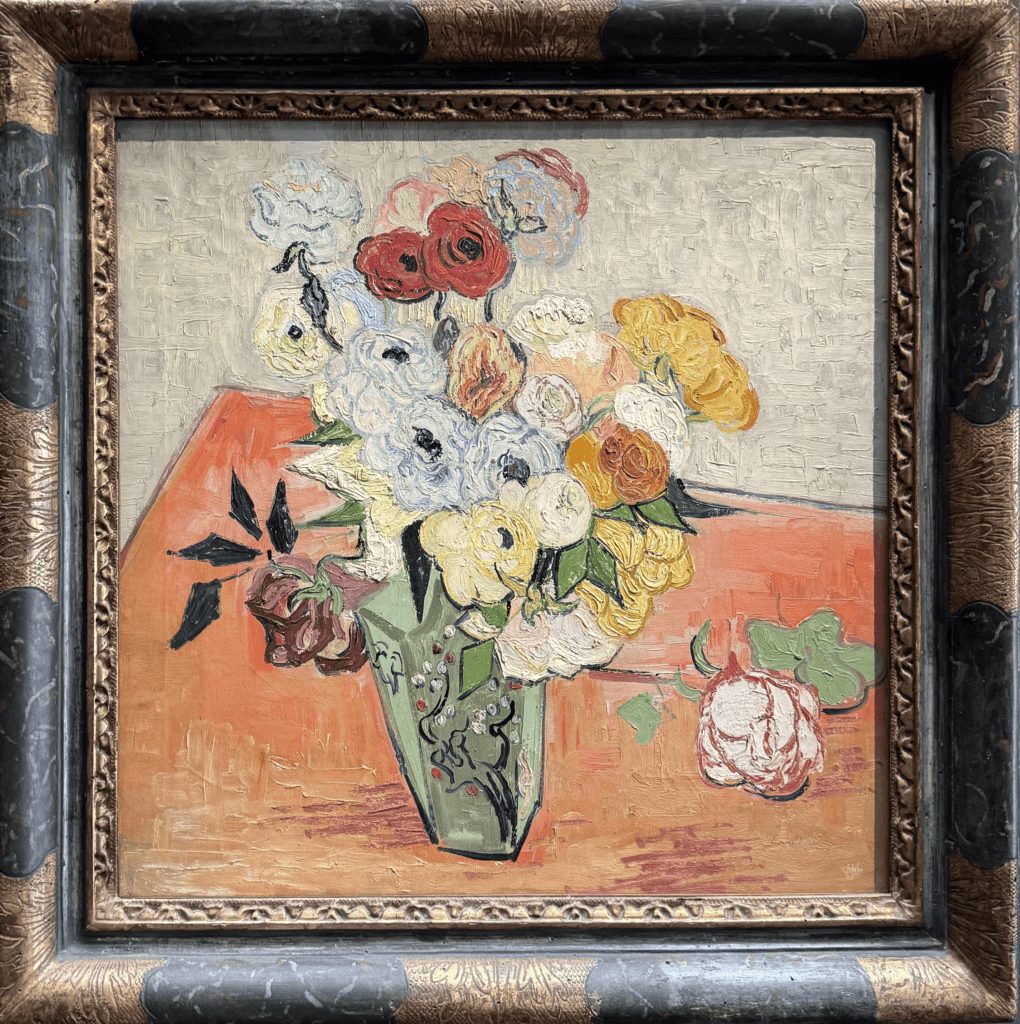
“Roses and Anemones” Vincent Van Gogh, one of his last works. He dies in Margaretha’s birth year. The work hangs in the Musée d’Orsay. (1986) Godfried and Mia are invited to Paris for the opening of this museum.
Margaretha is acquainted with a doctor from Aarschot, but her brother Arthur insists that she put an end to the relationship so that the fortune can stay within the family.

The proud Margriet… who doesn’t know her? With her brother Richard Van Kerckhoven (1880-1947). Richard is postmaster in Brussels and Godfried’s godfather.

Besides the mass in their own chapel, the praying continues in the Sint-Michielskerk in the Naamsestraat.
The church was built between 1650 and 1666. The church was almost completely destroyed in 1944. Only the facade was spared, as if by a miracle. The reconstruction of the church was completed in 1950.
In the church you will find a reconstruction of a baroque organ on which the music of J.S. Bach can be performed in the best conditions.

Bertha Van Kerckhoven (1894-1963)
At the end of the Second World War things are not going well for this aunt of Frie. She witnesses the enormous devastation of the bombings. Through post-traumatic stress disorder Bertha ends up in a wheelchair for the rest of her life.

Bertha and Jos

Bertha with her little nephews Paul and Jos at Leuven fair
Elvire grows up as the youngest in a family of nine children

Elvire Van Kerckhoven (1900-1986)
Elvire studies at the boarding school in Laeken, in a highly regarded convent school run by sisters, open only to ‘young ladies of good standing’. There Elvire is under the care of her uncle (the war orphan Richard Vermaelen) who is assigned the post of parish priest there. Later she joins in the business in Leuven and takes care of the shop window, which she calls “de veu doen”.

Elvire was witty and sharp and full of life

Elvire, Josse, Jos (photo: 1964)
“ Josse and Elvire are husband and wife. To be able to tell the two ‘Josses’ in our family apart, one of them has to wear earrings and be called aunt. ” – reasons Pieter as a toddler
Everything comes back

Miu Miu can call itself the undisputed it-brand of the moment, and that makes Elvire’s shoes coveted collectors’ items. (photo: 2025 collection)

Elvire Van Kerckhoven (1900-1986)
Diamonds are a mere trifle for the immensely rich Elvire. She gladly spends a lot of money on them and during the wartime flight she takes the gemstones with her sewn into her dress.
“We took two cars with chauffeurs and fled to France. We arrived at a castle that we could rent. But then the Germans came. And we were afraid that they would drive us out. But our Margrit could speak good German, because she had been at boarding school in Brussels. And we agreed with the officers that we would split the castle. The soldiers pushed cupboards in front of the inner doors so that we could not disturb one another. From there we still bumped into each other and then the officer said: ‘The French are dirty people’, we had to laugh a lot about that.” – the aunts (According to Mia the German soldiers pushed the cupboards aside again at night…)

Elvire, old but still sharp (photo: 1976)
Listen to an interview by Pieter with his great-aunts Elvire and Josse (recorded on a cassette tape around 1977):

Josse, Rev. Richard Vermaelen, Elvire (photo: 1964)
Attached to Elvire are not only quite a few very expensive jewels but also the story of the atrocities in Aarschot during the First World War. She is detailed in her accounts to the point of the autistic. We know every wafer-thin detail of what happened in Aarschot during the First and Second World Wars.
“ All the men of the Martelaerenstraat were taken out of their houses and shot dead, including our uncle Richard.
On 28 August 1914 we were locked up in the Church of Our Lady while the town was systematically plundered and burnt down. After futile attempts to set fire to the church with many people of Aarschot inside it, our family had to go on foot under duress to Leuven, where we were housed in a stable with straw. Officers smoked cigars and, laughing, let the burning ash fall into the straw. ” – Elvire

Elvire is a fan of the tenor Rudolph Schock. The distinguished lady watches, fascinated, the New Year’s Concert of the Vienna Philharmonic, which is in the hands of ‘das Wunder’ Karajan. The music is magnificent, the orchestra a dream, and Elvire claps lightly along to the ‘Radetzky March’. Pieter is put on a little bench by Elvire and with a pencil he conducts like a top conductor the Viennese polkas, marches and waltzes. Elvire is passionate about the television series ‘The Forsyte Saga’, filmed in 1967, about an arrogant Victorian family.
Dean-parish priest Berghmans brings Elvire communion at home every week and receives for it 200 francs, a box of 25 Corps Diplomatique cigars at 16 francs apiece and 2 packs of Côte d’Or milk chocolate for the sisters of the Institute Sancta Maria. With the help of a pint of Tuborg, Elvire, with gouty hand, takes the super-dry Body of Christ.

Eric B., the son of the pastry chef Délecta on the Grote Markt in Aarschot, where the aunts were customers.
In conversation: the pastry chef’s son about Elvire and Josse (recording 2024)

” L’élégance est la seule beauté qui ne se fane jamais “

This Balenciaga designer bag dominates 2025
Inspired by Elvire’s handbag, but with a slouchy frame, the Balenciaga Rodeo made its debut in the streets of Paris during Couture week. Elvire could already count this timeless handbag among her biggest fans.

The seven sisters regularly go out with their brother Arthur and they line up neatly for it. With their familiar attributes of prosperity and standing: beautiful cars, jewels, fur and Champagne in silver cups for the journey.
If something or someone is still missing from the family portraits, it is Frie’s mother. Clementina is overlooked every time. She sells fabrics and fur coats from Monday to Sunday noon to secure her sons and their descendants as far as possible financially. She feels treated without affection by the aunts. Aunt Josse takes and develops the photos herself.
One thing is clear: the aunts’ powerful connections help Frie and his brother, who is studying medicine, get ahead. The university was much smaller than today and initially French-speaking. Among the professors there were many clergymen.
Who is the Bug?

Of the dead (almost) nothing but good: this is what Elvire, Josse and Godfried said about Canon Van Buggenhout.

Canon J.B. Van Buggenhout, professor (1875-1952)

The professor lives with the Misses Van Kerckhoven in Leuven. A chapel is fitted out for Van Buggenhout. Proud Elvire is the sacristan there. The aunts love their lodger, the canon, dearly.
The crucifix on the altar was donated by Guy Van Kerckhoven to the church of Le Contadour in Provence.

“ Here the little altar of my house chapel, on the Lavorenberg. When will Fried come here to serve Mass? ” – J.V.Buggenhout (the aunts’ house in Leuven is situated on the corner of the Oude-Markt, the Parijsstraat and the Lavorenberg)


“ My sturdy sacristan, aunt Elvire, should have stood up for it. I regret it! ” – J.V. Buggenhout

Elvire with the bottle, the man in the picture is Arthur, Godfried’s father. The girl at front left is Tinkeke Van Dyck, Godfried’s mother.
Den Bug (that is what Van Buggenhout is called) is a great wine lover and regularly organises a wine evening at the Misses Van Kerckhoven’s. The well-known Leuven wine firm Boon-Hecking from the Vaartstraat supplies the wines. On those occasions he invites his colleagues from the Faculty of Medicine, among them the eye specialist Professor Appelmans, nicknamed ‘the Apple of the Eye’. To his students as well as to the Misses Van Kerckhoven, ‘the Apple of the Eye’ repeats: « Look in my eye. » His brother René, professor of Surgery, nicknamed ‘the Pee Apple’, is also invited. (At that time no distinction was made between surgery and urology. It was a subordinate orientation within Surgery). They came to visit there regularly. The aunts’ ‘Weinstube’ is well known at the Faculty of Medicine in Leuven. Church dignitaries from Mechelen are also regular guests of Frie’s aunts.
“ The men from Mechelen came driving up to the Oude-Markt dressed in mauve in limousines with chauffeurs. The neighbours were impressed every time. ” – Elvire

Van Buggenhout teaches Chemistry to the first-year students of the Faculty of Medicine.
In her old age Elvire repeats with the regularity of a cuckoo clock what the key figure den Bug used to say:
- Und so geht alles for über und so geht alles vorbei, but a little piece of cake can still be squeezed in!
- La vie est amère et les pommes de terre sont chères! (as a clergyman he could hardly say ‘Les femmes sont chères’. Moreover he was permanently spoilt by Margharitha, Bertha and Elvire)
- When it is your birthday you get to hear from den Bug: “Twenty years growing, twenty years blooming, twenty years standing still and twenty years decaying.”

The Mature Age (1902) – Camille Claudel (1864-1943)

L to r: Margaretha, Cécile, Jos, Bertha, ?, Maria, Clara, Sylvie, Canon Van Buggenhout, Paul, Frie, Arthur, Elvire
Never underestimate the power of the seven sisters.

the canon, Josse, Elvire

L to r: Frie, professor Van Buggenhout, Elvire, … ?…
“ For those of Leuven, Aarschot was not chic enough. ” – Frie
In 1960 Elvire and Bertha return, in an atmosphere of mourning, to the parental home in Aarschot, where Josse has remained after the death of their sister Margaretha. But what is in the barrel does not turn sour. Elvire hangs a portrait of herself on the wall to the right of the chimney and one of professor Van Buggenhout to the left of the chimney. Whenever Elvire bears a grudge against den Bug, his portrait is replaced by that of the pope. Between the sisters and their canon it had been like a tragicomedy of ego and envy. The church community extracted money, art and silverware from them. But when the pope appears on television, her sister calls out to Elvire in ecstasy: “ Vie, hurry up and get here, the pope is on the telly! ”

Clara, Maria, Arthur, Tineke

Alfons Dille, of Scheut (1908-1980) the Van Kerckhoven family supports the projects of the missionary in China and Congo


? , ?, ?, Tineke, ? , ?; Arthur, Maria, ?, Sylvie

Arthur, Elvire, Tineke, Maria, Cécile, Sylvie, Margaretha, Clara, ?
Elvire (39) and her six sisters are close friends.


Cécile, Arthur, Tineke, Maria, unknown, Elvire

(1990) Why does the film ‘Tatie Danielle’ remind Pieter of his great-aunts?

Margaretha and Rosa Van Kerckhoven (photo: 1958)
Besides their three nephews Paul, Jos and Godfried, there is still a hidden cousin lying in wait: Rosa, the daughter of uncle Richard, about whom not a word is mentioned. Until she launches a charm offensive and regularly comes by train to Aarschot to visit her doting aunts. Rosa wants to move in with the aunts. If one of them were to die, that could be useful. Little Pieter regularly visits the doting aunts and reports back to Frie: “Aunt Jos flew into a rage again: Arthur’s lot (Paul, Jos, Frie) must not think that it will all go so easily. And aunt Jos took a large brown envelope containing the will out of the mahogany chest of drawers and threw it across the drawing room.” Pieter urges his great-aunts to be careful of that Rosa because she is not chic, a completely different style from ours.

” La tendresse a des secondes qui battent plus lentement que les autres. ” – Romain Gary
To safeguard the inheritance, “Arthur’s lot” decide to visit their aunts daily. Mia also makes an effort and bakes a pheasant for them. A recipe by the Michelin-starred chef Roger Souvereyns of Scholteshof, bien évidemment. But the aunts do not follow food trends, they are not cool enough for that. “That pheasant of Mia’s, we couldn’t get it down. She puts far too many herbs on it. We tried it and threw everything in the bin. Our Marja, she could cook game well.” Indignant, Pieter takes revenge on the aunts’ cuckoo clock. Standing on a chair he pulls the Black Forest bird out of its little house. But the wooden bird does not come loose from the rod. From then on the little wooden door stays open and the cuckoo dangles bent downwards.

‘Coaching Taverns’ 1828 Royal Tudor Ware from Staffordshire used by the aunts
Is Godfried’s stamp collection still worth anything?

Like many children, Godfried collected stamps and his godfather Richard Van Kerckhoven helped him with it. Richard is a brother of the aunts and postmaster in Brussels. Years later Godfried proudly shows the stamp collection to his offspring. Frie explains which type of Belgian stamps are really worth something. Pieter soon finds that dull as ditchwater and promptly decorates the drab Belgian stamps with felt-tip pens. From the first to the last, members of the royal family get red lips, earrings, eye shadow and still more frivolities. Frie is in shock when he discovers the disastrous ruination of his preserved treasure and can tip the whole fuss into the bin.
The glory days of the Misses Van Kerckhoven, the once so influential seven sisters, are over. What remains of the status-obsessed empire?
X Studies >>>