<< XVII Frie and Mia have three children
Mia wants to leave the official residence at a busy crossroads between the Total and Gulf petrol stations.

The Wit Toreke is offered to Frie for sale at 250,000 Belgian francs, but Mia does not want to live there because an industrial estate is coming nearby. There are also plans to turn the Meetshoven wood into a villa district.

Clairette Serneels, Mia, Pieter (photo: 1976)
Godfried owes the move in the mid-1970s to the healthy forest air of the Averbode region to Mia.
Godfried is active in equestrian sport for decades
Frie stables his horses at “Het Sparrenhof”, a farm where Sus and Melanie live. When it turns out that a campsite is coming next door, Frie this time moves the stable, together with the whole family, a little further on. Frie, however, has it included in the deed of sale that Sus and Melanie may live at ‘Het Sparrenhof’ free of charge for the rest of their lives. This typifies Frie from head to toe.
Godfried is chairman of the ‘Bosruiters Langdorp’, jury member for show-jumping and dressage competitions, takes part in competitions and also teaches dressage riding himself. Horses are bred at home. Riders who do not have a horse of their own can borrow one from the stable of eight horses.

Gust, Staf and Frie win prizes


Godfried seems unable to lose with his horse. A whole wooden chest full of gold medals.

A nice story from the early seventies, when Staf and Nelly were the first caretakers at the Steenheuvels:
Mia drives the tractor herself with a hay tedder to dry the hay. Lending a hand, for Mia, is a bit of stepping out of line. Trendy Nelly in her white leather knee boots attracts the attention of passers-by. A walker addresses Mia: “That one with her white boots, is she the notary’s one?” No wonder the remark is only moderately appreciated by the notary’s wife concerned. She sends Staf and Nelly packing from the Steenheuvels on the spot.

Mia (42) is as attached to her house as Scarlett O’Hara to “the plantation Tara” from the romantic film “Gone with the Wind” from 1939.
“I say I live in the Averbode region. Everyone knows the abbey. It sounds nicer than Aarschot and the people of the Kempen are also kinder and gentler.” – Mia

Frie with Robbie

Pella with foal Willeke
“My childhood memories of the Steenheuvels date from the mid-seventies. As a teenager and member of the ‘Bosruiters Langdorp’, I learned to ride with notary Van Kerckhoven as instructor. To learn the correct posture, I was given a broomstick under my arms and a cigarette paper between my knees to get the right contact with the saddle. I can assure you, I learned to ride very quickly.” – Eric Bergen (2020)

Know your classics: Eau sauvage (1966)

Godfried wore Eau Sauvage, which was originally created in 1966 as the first men’s fragrance for Christian Dior.

Wolfsdonk of course knows Louki (1975-1988) Godfried’s Dalmatian. But the Van Kerckhovens have more dogs frolicking around. Mia is attached to her Groenendael and a Malinois shepherd dog. The long-haired dachshund ‘Nolleke’ is Gert’s darling.

Frie lends a hand to the brass band and the care of the sick

In his house, which acquires a mythical status as a harbinger of earthly paradise under Mia’s impulse, there is a constant coming and going of visitors. Here with neighbours.
ON THE ROAD IN WOLFSDONK

Who is Marie?
Marie lives on the corner of the Kiekopstraat and the Molenheidestraat, by the little chapel. Frie takes Marie along to the activities of Wolfsdonk such as funerals. When Frie has to miss a funeral, Marie consoles him: “My notary, the devil sticks somebody in the coffin. That one won’t see anything any more.”

“Marie’s little chapel” May is the month of Mary. In the Heidemolenstraat the artist Hilde Hermans is active as a volunteer and makes sure the little chapel is decorated with the necessary crepe-paper flowers. A centuries-old tradition in Catholic folk culture. In the past, women from the neighbourhood came together to make the paper flowers, with techniques like those used for paper flowers at the seaside. (photo: 2024)

Marie Naulaerts Theys (1911-2016)
The esteemed Marie lives in her living kitchen where a Leuven stove glows. Marie explains that as a child she had to walk through wind and weather, even during the winter months, through the dark woods far to school. Marie keeps chickens and sells eggs, but also has a pig which you may go and look at through a wooden hatch. Everyone gets sweets from Marie.
Marie herself is quick to echo that Pieter should be careful with all his “good intentions” :

Husband Leonard Naulaerts (1909-1996) ‘Nakke’ worked in the mine. Marie comes once a week to help Anna with the housekeeping at the Steenheuvels and Nakke comes to hoe the weeds. Marie is constantly gathering ‘deenetoope’ (pine cones). Marie hangs baskets and big sacks on her bicycle and searches and gathers until they are loaded to overflowing.

The young Pieter idolises his mother, who regularly stays in Paris. ‘Seul dans sa chambre’ he leafs through Mia’s dazzling magazines: Jours de France, Paris-Match, Vogue, Marie-Claire,… . Later he too wants to play the big shot in Paris. In time Mia, just like Marie, starts gathering pine cones in the wood. To stoke the fire, stay fit and live to be as old as Marie. Parisian Pieter now uses Mia’s pine cones as Christmas decoration. As in a fairy tale, Mia also becomes a hen-keeper of Mechelen cuckoo chickens. After the marten bites their throats through, a chicer chicken makes its entrance, namely ‘la poule pondeuse Bleue des Landes’. (2023)

Hen hatching fools – anonymous – oil on panel – Belgium or the Netherlands – (16th century)
According to a myth very popular at the end of the Middle Ages and in the Renaissance, fools are born in eggs.
I am glad I have known you

Caroline Van Vlasselaer (2024)

Caroline Van Vlasselaer and Pieter (photo: 2002)

Godfried on holiday to restore mind and body. (photo: Provence, July 1979)
“Read or do something useful.” – Frie repeats countless times to his children
“Un enfant qui lit sera un adulte qui pense.” – Victor Hugo
Accident May 1979: during a walk with an English thoroughbred, a group of riders gallops past. The stallion gives chase. Frie pulls the reins, Lord rears and Frie falls onto the concrete road. His arm and upper body are in plaster for half a year. Frie is devoted to his horses, but Mia wants nothing to do with them. And so the horses disappear from the Steenheuvels.

Frie and Mia together with the neighbours Clairette (1936-2024) and Dr Marcel (1935-2025), Walter (+) and Maria

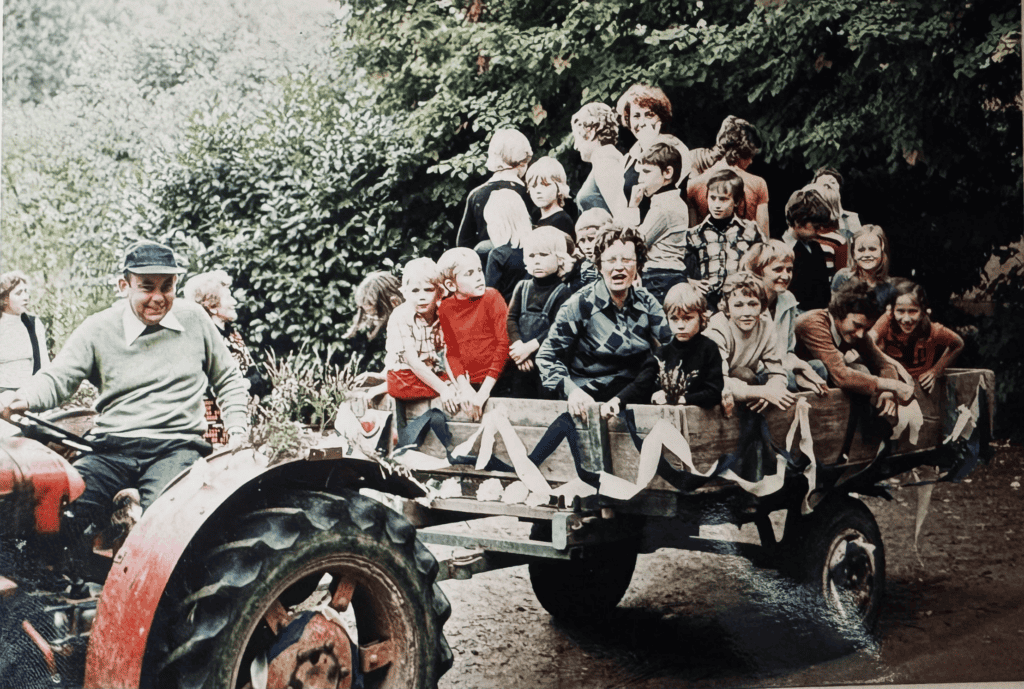
(mid-seventies) Godfried drives his tractor on the occasion of a Flemish fair he organises with Clairette for the children. Pieter stands at the front in the corner of the hay wagon – to his left Clairette – to the left of Clairette stands Gert – the little boy in the red jumper next to Gert is Peter Macken

Clairette (1936-2024) of Kabouterland, the neighbour organises one supper after another, noting the details in six books. Almost an entire book is devoted to the Van Kerckhoven family.

Kiki Didden and Wim Schoomeesters
Kiki Didden from Langdorp records a message on the occasion of the passing of Clairette (2024)
Kiki Didden and Pieter out together in Antwerp (2026)

Clairette teaches Pieter to play the zither


“When the Van Kerckhovens come, we serve crayfish from ‘t Scholteshof.” In the 1980s and 1990s Roger Souvereyns won 2 Michelin stars as chef of the well-known restaurant Scholteshof in Kermt (Hasselt).

Other guests of the local gentry are allowed by Clairette to “fork in crayfish from the Unic”. Yet most of those people are much richer than the Van Kerckhovens.

Portrait of “authentic people”
Frie and Mia are happiest, have the most fun in the company of ‘real’ people from Wolfsdonk. Not comparable with the gangs of nouveaux riches they frequent.

Fonske Steurs (+), Gert, dog Nolleke, Josée Viskens (+), Louis Steurs (1924-2006) from the Elsleuken. The Van Kerckhovens regularly visit Louis and Josée in the Elsleukenstraat. Louis slaughters Frie’s rabbits. When road worker Louis Steurs is struck by a very serious accident at work, he ends up for months in a hospital in Hasselt. Because his wife cannot get there, Mia drives to the hospital in Hasselt with Josée every day during his rehabilitation. Josée Viskens is the daughter of Sus and Mélanie, who lived at the Sparrenhof. Louis is of the opinion that Pieter should become a “wit-hiejer” (white lord, Premonstratensian, priest) of Averbode abbey. “Those men have a fine life.” As a young lad Louis played at the Heimolen. When the mill was working, the miller put little Louis on a full sack of grain and he was hoisted up with a rope towards the grinding floor. Halfway the miller fixed the rope. Louis dangled in the air and the miller peed on his head.

Louis and Josée have a well-kept flower and vegetable garden, a gigantic aviary with peacocks, a golden pheasant and a tame jay that spouts swear words. In their spotless kitchen sits a Japanese nightingale that no longer sings and hardly moves because it had sat on the burning stove. Louis had had to pull it off. Pieter sits with his face right against the cage looking at how the little feet have half melted away. In his quick, high little voice he asks for the umpteenth time whether they would please explain once more exactly how it happened. Fonske, Louis’s brother, remained a bachelor because his mother wanted him to care only for her. Fonske lives right in front of his brother in the parental farm (anno 2025, caterer Koen Verbeeck, Elsleukenstraat, number 4). Alfons Steurs often sits on his long white bench, on the street side in front of the little farm, smoking a pipe. Spontaneously neighbours come out and sit down next to him, but cyclists from around Wolfsdonk also stop and sit down to chat cosily. A lot of fun is had there. In the humble little house right next to Fonske’s farmstead lives the Bèkke, whom nobody wants anything to do with. Pieter waits each time until Bèkke comes out. Bèkke leans over the concrete fence and explains: “If a pigeon has flown badly, then I wring its neck straight away. Or I smash its head in.” Pieter is not allowed by Josée to go up to Bèkke. “Behind his house is a swamp, where they say the little children were swallowed up.” Alfons Steurs works in the printing house of Averbode abbey, where he lets children’s magazines roll off the press. Weekly Fonske reads aloud at the Wolfsdonk mass. The Holy Scripture rings out very loudly in a mix of Wolfsdonk dialect and refined Flemish, with a strong nasal sound because his big nose is crooked. Every year Fonske goes with the parish towards Lourdes, where he takes endless numbers of slides which he afterwards shows all to Pieter. Fonske’s canary is allowed out of its cage and sits on Fonske’s shoulder. The “littlebird hops up” onto the rim of Fonske’s dinner plate.

“Pour mettre dans vos pas mes pas trop hésitants, s’il vous plaît, Bernadette, prêtez-moi vos sabots…” (la prière des pèlerins)
In Fonske’s living room stand life-size plaster statues of Our Lady of Lourdes, Bernadette Soubirous and a colossal statue of Christ. Unfortunately the impressive sculptures were completely worn and stripped, but Fonske had had them restored to their original state and repainted in magnificent colours.

The brown Mazda 323 in which Fonske drives to the shop with Josée every week gleams like a mirror.
NATURE CONSERVATION
Frie experiences forest management himself. In the first half of the twentieth century monotonous plots of conifers were planted everywhere, among other things to prop up the Limburg mines. Frie is not a modern nature manager who makes the woods more varied, more naturally beautiful. Original pine trees are felled and cut into blocks by a screaming chainsaw. All for stove and open fire.

Frie goes into the woods with his children, also late in the evening with paraffin lamps: timeless beauty in the darkness.

Gert, Ilse, Pieter and Frie
“Nature tolerates your spying on her, not your unravelling her.” – Pythagoras

Snow offensive with cross-country skiing goddess Mia and giggling Clairette Serneels (photo: Langdorp, 1977)

This lane of beech trees was planted by Frie with his own hands. “Little tree grows tall, little planter dies” (Buimmeke groewet, ‘t menneke doewed) – Frie
A moment to pause in the restored house where the 19th century lives on. On entering you smell it at once: the soothing scent of floor wax. The embellishments with facade ornaments and decorative beams come from a demolished monastery near Leuven. Around the house lie cobblestones that come from a military barracks. The roof tiles previously served on the sheds of a former brickworks in Ramsel. Frie could snap up everything for a song. Note the fireplace with early 16th-century carved fragments in blue hard stone. On the right a dancing couple of humble origin, behind Frie noblemen dance. To every visitor Frie explains how the fireplace is made of blocks of rust-brown Diestian ironstone that had once been used for the walls of a dunghill.
Oh, little sheep and dwarf goats!

Ernest Vanden Panhuysen (1874-1929) – oil on panel
“Velle suum cuiqui est” – Persius (What a person wants is personal to everyone)

Ilse (photo: Steenheuvels, 1981)
A badly judged episode is when Ilse gets dwarf goats at the animal market of Heist-Op-Den-Berg. Every other moment horns get stuck in the fencing wire, with endless bleating as a result. Frie realises they are droppings-producing, money-wasting animals. As a hint the neighbour secretly slips Frie the recipe for a goat-meat stew. Then comes the butcher “the drunken white Wuyts” to slit the throats of the fairytale-like little animals. The habit of cosily talking about the little goats with Ilse when she comes home from boarding school is over. Their little pelts now adorn her bedroom. This touched Ilse deeply. 35 years later those goat pelts lie over the armrest of her chair.

JAR clip “Suffolk sheep’s head” fine pearls, sapphires, aluminium, silver, gold (2006)
Frie breeds Suffolk sheep with black head, black legs and fine white wool. Mia and the children do not like mutton. One day Mia notices freezers full of sheep. Then you simply dig a big pit to dump the freezer bags in

Pieter, Colette, Gert, Ilse and Frie
”Every heart sings a song, incomplete, until another heart whispers back.” – Plato
There is hardly time for cosy get-togethers, but to close a Christmas dinner Frie, the mother-in-law and the children line up all their favourite Christmas carols, followed by a little present. The children have few toys. But they do have motocross, building camps and romping about. Whoever asks about their childhood automatically ends up at the woods.
Do you live on a dirt road? And are you happy with that?
” At least as interesting is how I saved the Steenheuvels, a magnificent piece of landscape heritage, from being asphalted. My father hated driving through the puddles of the unpaved road. ‘You always sit in such an old banger. And with all those potholes, that’s not good for the shock absorbers, is it! A little road in macadam, that would be a dream, wouldn’t it!’ – Frie He went flat on his belly for King Car and convinced the town council to release money quickly to disturb the idyll with a road surface. Then I got involved. I asked the then mayor Rik Daems to spare the centuries-old ‘pearl’ of the Langdorp landscape from asphalt. Rik found my objection hilarious, pointed out that the request came from my father, but promised to take it into account. Dad nearly jumped out of his skin over my intervention.” – Pieter

Frie often opens a good bottle of wine as can be seen in the photo that Pieter took.

Olympia (Greece) ? Around 460 BC. Dionysus, god of wine? The left arm, deliberately unfinished, was hidden under a short cloak (chlamys). The god probably held a kantharos (a wine-drinking vessel) in his right hand. Resting on the left leg, the foot placed flat, he bends the free leg. The craftsman is still feeling his way in balancing the statuette: the free leg is too long here.
“Le vin est un objet luxueux et l’ivresse est désordonnée“- Salomon
“Le pauvre est un imbécile quand il est ivre et qu’il se croit riche.” – Marcolf
Dialogue de Salomon et Marcolf, 12e siècle

From the Generale Bank Frie receives every year a card with the rating of wine vintages and an indication of the keeping potential. Godfried keeps the vintage chart in his wallet. An aid for choosing wine in restaurants but above all for patiently building up a wine cellar. There also lies a so-called case “château migraine” from the Aarschot plonk dealer Geens of “de Torens”. “Not to be drunk, old chap, in case the gendarmes turn up unexpectedly.” – Frie There are even a few bottles from Frie’s First Communion. Mia is fed up with all those old heavy wines and tips “le vin le plus prestigieux du monde” into the casserole with the saddle of hare or the pheasant. Mia only drinks young bottles. “Isn’t that a shame? All those good bottles going to waste, aren’t they.” – Frie Subsequently Pieter, who lives alone above the office with his boyfriend Wim and guests, empties the cellar: Château Ausone “Un vin monument, comme un rempart au temps: sur lui les années passent et subliment amoureusement son caractère”, Château Beychevelle, Saint-Pierre, La Tour, … . Each time Wim combines all the 1er Grands Crus Classés with spaghetti. When Frie hands over his office there are still a few hundred bottles of white and rosé wine going to waste. Frie says Pieter must throw everything in the glass container. The full bottles break in the bottle bank and “the smell drifts over the Elisabethlaan right into the cellar of the neighbours opposite; at Pelle and Renier’s.”
“Dum vivimus, vivamus” (Let us enjoy life as long as we live)

Godfried and Armand
XIX Anna and Marcel