www.johandockx.be
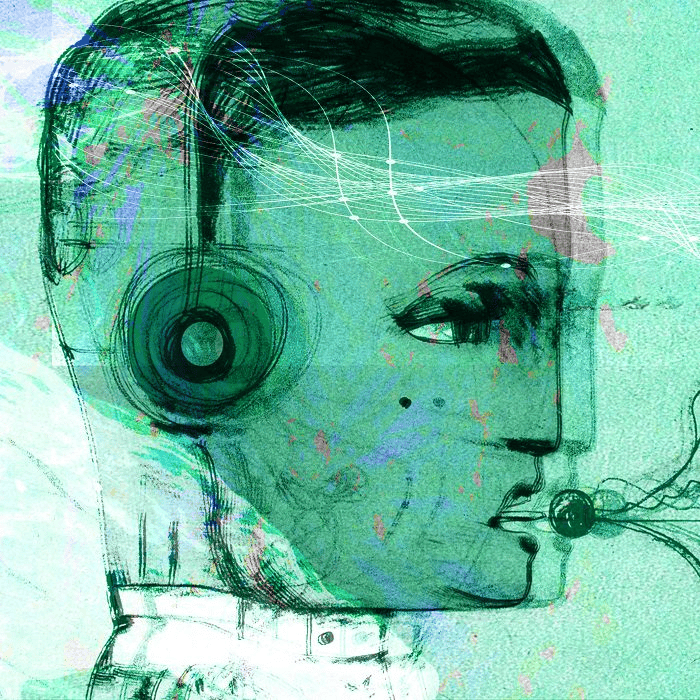
Somewhere along the way – Art-work CD
Johan Dockx has lived in Langdorp for years. His talent, his sense of aesthetics, his various techniques and the masterly way in which he can translate a concept into an illustration earned him the Culture Council Prize in June 2024.
Dear guests, art lovers all,
Dear Johan,
On behalf of the ACR, I warmly welcome you to the festive opening of the exhibition by Johan Dockx ‘elke dag een nieuwe nacht’ (every day a new night).
Every year the ACR awards a prize to an artist who is connected in one way or another with our city. This year we did not choose the least. Johan Dockx is a graphic artist, illustrator and former art director at the newspaper De Standaard. He lived in Aarschot for a good ten years and afterwards settled permanently in Langdorp. His unmistakable talent, his sense of aesthetics, the various techniques he uses and the masterly way in which he can translate a concept into an illustration are why he receives this prize from the ACR.
Drawing and reading is life for Johan Dockx. As an avid reader of De Standaard, I know and love his work. His drawings of people and animals, of nature with its fauna and flora, his illustrations of the things of the day are beautiful, and then there are the fascinating portraits of writers that he draws for DSL.
When I first met him – dressed entirely in black – I got a fin-de-siècle feeling. Before me stood a stylish, courtly person, an aesthete who coincided with many of the portraits of writers close to his heart, such as Pessoa, Baudelaire, Kafka, Rilke, Connie Palmen, Harry Mulisch, Jeroen Brouwers. I pick one out entirely at random: the portrait of the writer Katherine Mansfield, born in 1888. She is among the masters of the short story (Puur geluk). She was a bisexual New Zealand writer who emigrated to England and was very ill: she suffered from tuberculosis. And she suffered from the separation from her husband, John M. Murry, whom she adored. She found stability with Ida Baker, her ‘wife’. Even when her illness was at its height, she kept writing. She died at the age of 34 and in the Bloomsbury circles in which she moved it was said that she had ‘a face like a mask’, that her true nature was elusive … Well, that is certainly not counted in the portrait that Johan Dockx made of her. Her frail little face, framed by a bob, catches all the light from the right. You are drawn towards her eyes: they do not pierce, they do not mock. The way she looks at you does not let go of you. So much can be read in her gaze.
It is therefore only natural that the ACR (the art acquisition committee) chose his magnificent series of 16 literary portraits, which will get a fine place in our library. His colleague Karen Wijckmans says of it: “It looks like a piece of cake, spontaneous and therefore so strong. Nothing chafes in his portraits. Everything is right within the idiosyncratic universe that Johan creates. And yet every portrait does honour to the author. Every portrait reflects the personality of the author.”
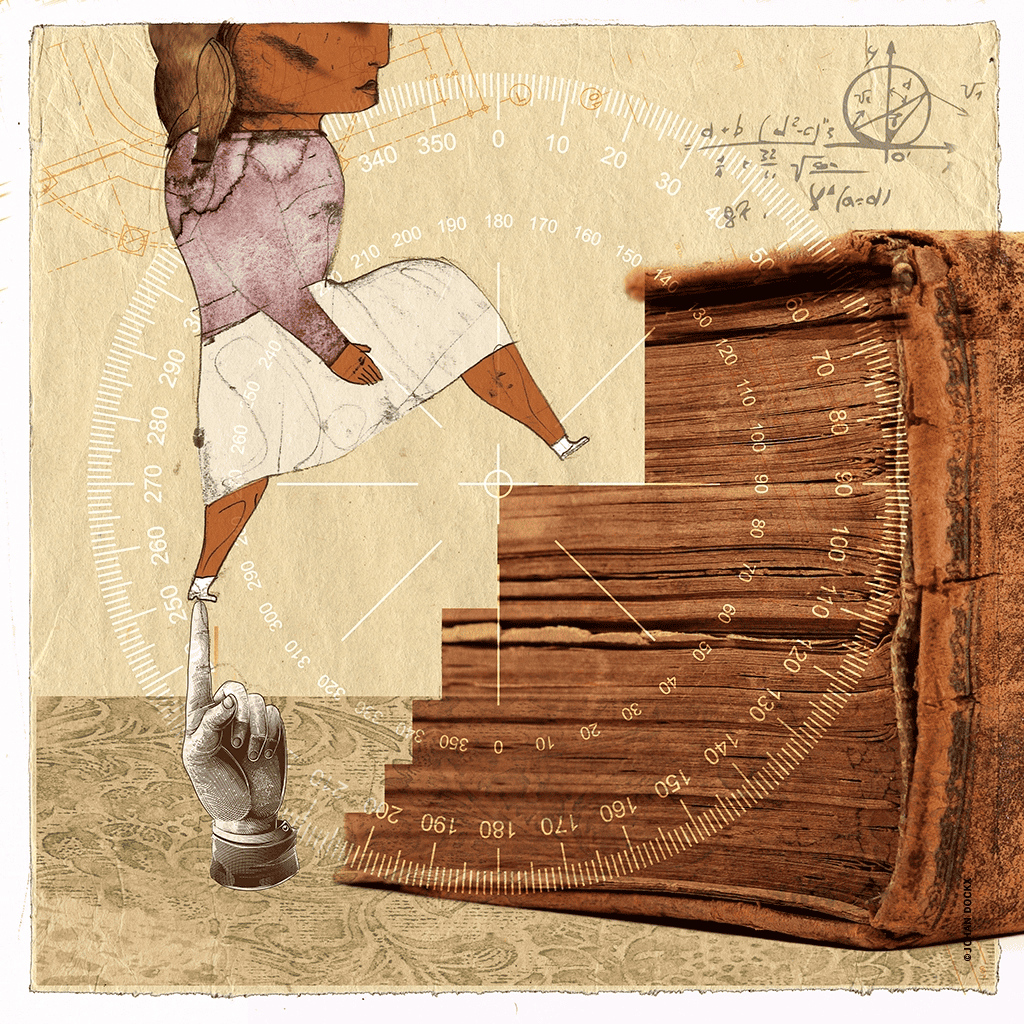
Johan Dockx is also generous. He felt how much we liked his drawings. He let us choose 5 extra works for our city. You can admire them all here: lady with hat, lady as bird of prey, a portrait of the opera diva Maria Callas, one of Leopold II, King of the Belgians, and the writer’s portrait of Franz Kafka, who let Gregor Samsa wake up as a beetle. You do have to pay attention: nothing is shown ‘just like that’, everything is meaningful. It sometimes takes a few seconds before the meaning reveals itself. And that is what makes his illustrations so fascinating. The viewer who takes the trouble to stand still at his drawings experiences a small inner journey.
2 / 2
For indeed, to try to penetrate to the essence of Johan Dockx you have to look closely at his work. Work that knows many styles: from collages through beautiful portraits and animal drawings in pencil and pen, to mixed media. In very many of his works pencil, charcoal, ballpoint, India ink, photos, scans or even coffee stains meet.
His colleague at DS, Astrid Houthuys, says: “Whoever wants to find out something about Johan Dockx has to be shrewd. Like a vanishing artist he comes and goes like ebb and flow. By day this Dockx is a human being, by moonlight he becomes a raven. Restless. Ancient. (But whoever knows him knows: he never lets go. Gives up on no one.) A Dockx works hard, preferably at night.” I can confirm that. In the run-up to the setting up of this exhibition I myself could expect emails from Johan ‘after dusk had fallen’ or, I quote: “I will send more explanation tonight”. The title of his solo exhibition therefore speaks volumes: ‘elke dag een nieuwe nacht’. That hard work is his credo he let slip at another meeting when he referred to his favourite author R.M. Rilke, who asked the sculptor Rodin: “How must one live?” To which the latter replied: “By working.” Tens, hundreds, perhaps a thousand times Johan stood before a blank sheet to draw left-handed or to make illustrations from a concept. For this exhibition he has therefore selected a rich quantity of his work.
Where does he get the inspiration from every time? Where we use the word inspiration, Johan speaks of ‘gentle breathing-in’, the product of hard work and dedication.
For the newspaper Johan illustrates the columns of theatre maker Josse De Pauw and recently also those of Maj Vandergeten. By coincidence Maj began her career as a jack-of-all-trades in the editorial department of DS, after which she rose through the ranks. Now, so many years later, at a still fairly young age she had to move to a Limburg residential care centre because of her husband’s rapidly progressing Alzheimer’s and her own Parkinson’s. Last year in October Josée Lehon published her beautiful poetry collection ‘Vier met mij, dans met mij’, after which Maj accepted the offer to write a fortnightly column in DS. For each of her columns Johan made a drawing. It is not just any drawing, but a sensitive interpretation of what Maj writes, each time with a hand or hands at the centre. According to experts, drawing or painting hands is very difficult. Here Johan Dockx shows his mastery. We are therefore very pleased to be able to show you these moving illustrations first today.
Dear people, all that remains for me is to congratulate Johan Dockx on this expo and on his ACR prize. I also wish to thank the city of Aarschot and the entire museum team and all the staff of CC Het Gasthuis, and in particular Roeland Holemans. To you I offer my invitation to ‘read’ Johan Dockx’s work, work that goes to the essence of our existence, to be accepted with both hands.
Agnes Hendrickx
Chair of the Aarschot Culture Council