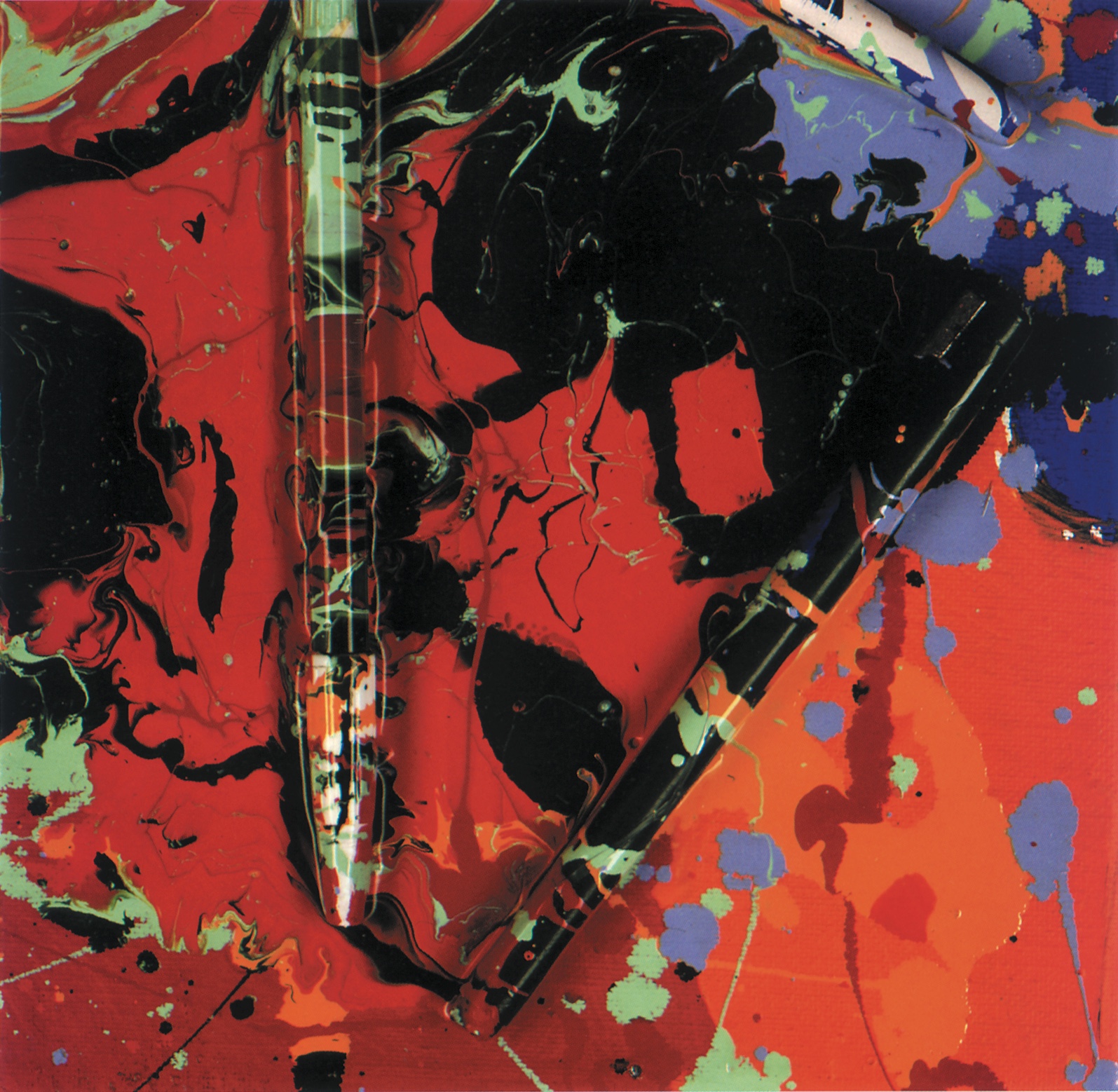
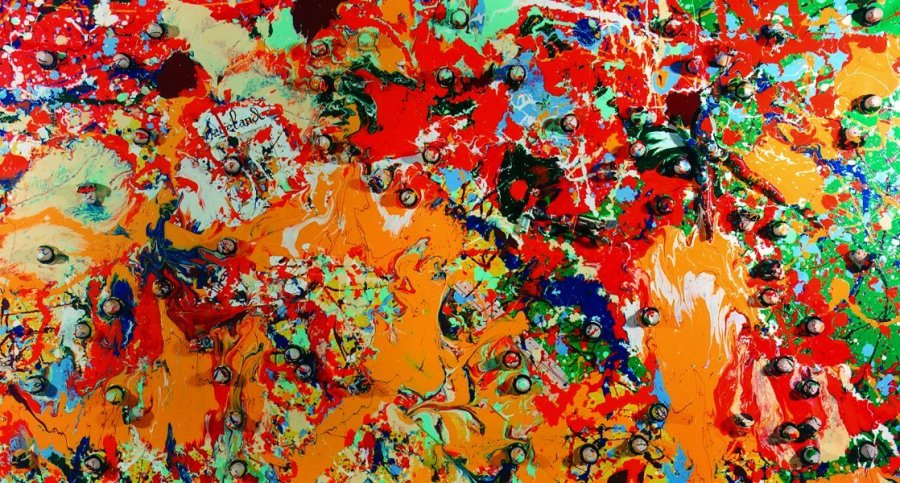
The painting method of Rik Daems is anything but orthodox, at least compared with the traditional approach. Instead of placing the canvas on an easel, he lays it flat on the floor. Instead of using brush, bristle brush and palette knife, he prefers to pour paint directly onto the canvas (the American Pollock, who became famous for it, called this the “dripping” method). Rather than trying to render the purely visual appearance of people and objects graphically, he probes the inner self and prefers to give them an entirely subjectively interpreted “image” (which is, after all, the most valid way of portraying someone or something). Rik Daems does not care about producing images or imitations, depictions or even imaginings. Outlines or figures or objects mean nothing to him. He attacks the colours head-on, not to subdue or overpower them, but to make them co-responsible and accomplices. He lets them run free, but orchestrates their autonomous urge to spread, their tendency to merge, their drive to overflow. He makes sure that yellow, red and blue remain strictly pure and unspoilt. They may run through and over one another, but not into one another! Like bright, glossy splashes of solidified lava they snake across the canvas, stretching or swirling, in touches or ribbons, in points or curls. But the master’s hand curbs the orientation of certain movements and brings more calm to some areas of emotions, memories, reflections and loose thoughts.But in this entirely abstract landscape, composed of flowing dots and stripes, extremely concrete everyday objects are unexpectedly and in a paradoxically direct way taken up and inserted: a tennis racket, the parts of a discarded computer, old paintbrushes and lids of tins or boxes… A worn-out but evocative reality thus enters a totally non-figurative world and is integrated into it because the paint floods over it. A bond is created between these everyday objects that were about to be thrown away and that suddenly acquire a new existence, halfway between their true but outworn identity and a poetic, purely plastic presence.Wim Toebosch