<< XII Rank and standing
“ Quod non est in actis, non in mundo ” ( What is not recorded in deeds does not exist)
In 1959, he is only twenty-nine, Frie succeeds notary Capuyns after his traineeship with notary Tuerlinckx in Haacht. Not bad: he is the youngest notary in Belgium and faces an enormous task in Aarschot. Frie is the first Dutch speaker the district of Leuven has known until then. At the same time his predecessor had not drawn up any deeds for a long time. The office can be reached through the Unic department store, behind the vegetable stall! Frie hones his skill at defusing thorny files and builds the office up from scratch into one of the most important practices of the Leuven district.
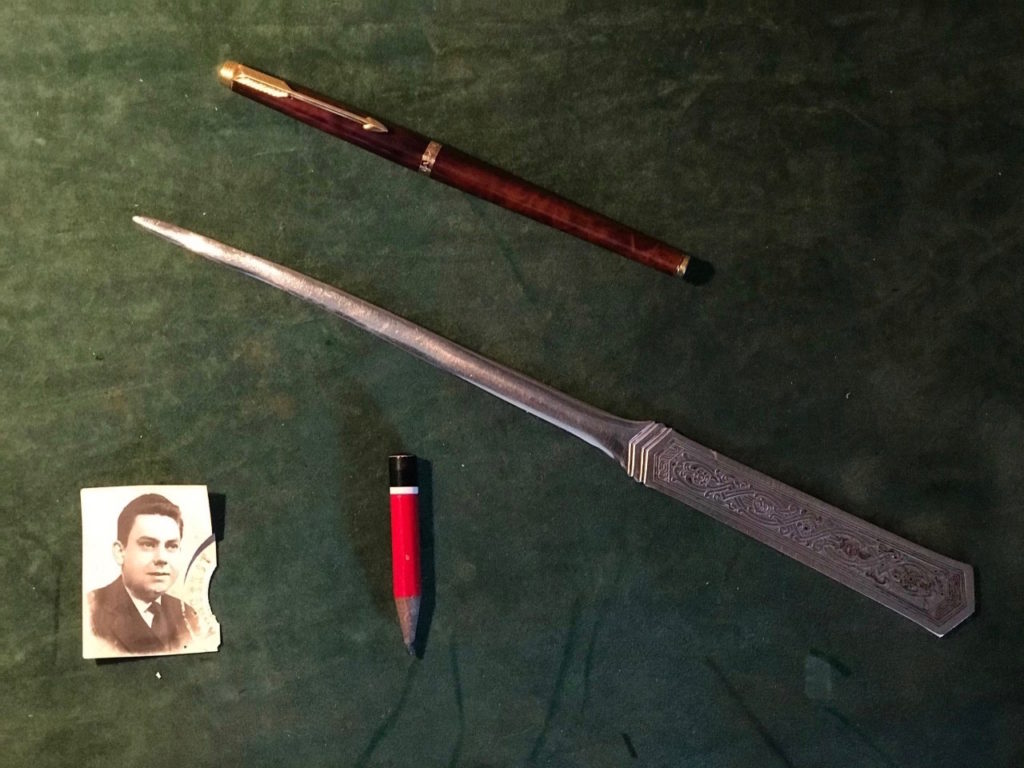
The letter opener with 39 years of service, pen and pencil.
(2011) READING BY GODFRIED FOR NOTARY PAUL LOMMEE
Your uncle, honorary notary Godfried Van Kerckhoven, appointed in Aarschot in 1959 with cantonal jurisdiction at the time, and notary until 1998.
A brief look at the notary’s office in 1959. Back then: no talk of urban planning, no tenancy legislation, no right of pre-emption, no OVAM, no EPC, no mobile phone, no fax and no PC. Telephone connections had to be requested from the exchange: “be patient, sir, the lines are overloaded”. A page and a half in standard format (then 50 BF) was enough for a deed of sale. With the exception of a deed of sale, the notary had to call on two witnesses (deeds of gift, marriage contracts, notarial acts of notoriety, wills). The witnesses were a fixed service to the notary and were indispensable. Public sales took place in a ‘little café’, except public sales with the intervention of the justice of the peace, always on Saturday morning. Employees were not lawyers and managed to rise to ‘first clerk’ through their own study and practice. They worked every day until six in the evening and on Saturdays until one in the afternoon. No stress at the office. A good clerk stayed loyal to the notary until his retirement. The notary’s weekend began on Sunday at one in the afternoon, because on Sunday morning the office was open. Clients were not hounded by TV, gossip magazines and the internet. They trusted their notary. One spoke of a regular clientele. Case law and legal doctrine formed the foundations of our legal system. Nothing changed until 1962, when the ‘misère’ began, with constantly new laws and decrees. I have great admiration for today’s notaries who, despite all the worries, manage to steer the notariate in the right direction.
Paul, aunt Mia and I myself are proud to have a notary in the family. With a view to a capable female successor, we still wish you a flourishing ‘fin de carrière’. Congratulations Paul on your birthday. Congratulations to your charming Geertrui (Geertje), your dear children and mother.
Your uncle Frie.
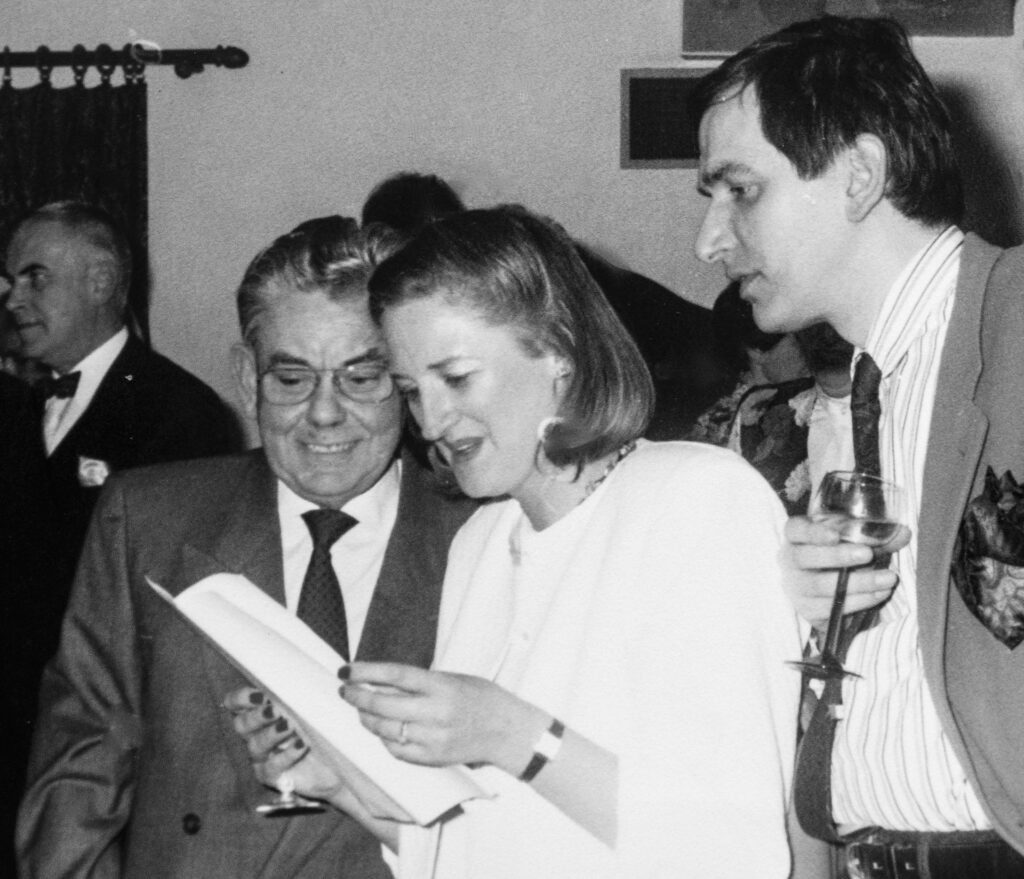
Harry Heylen, Godfried, Marietje Van Kerckhoven Rutten and Paul Lommée
In the office stands a chapel-shaped Art Deco clock that sounds the Westminster chimes every quarter of an hour. A long dining table by a Mechelen cabinetmaker is used as a desk.
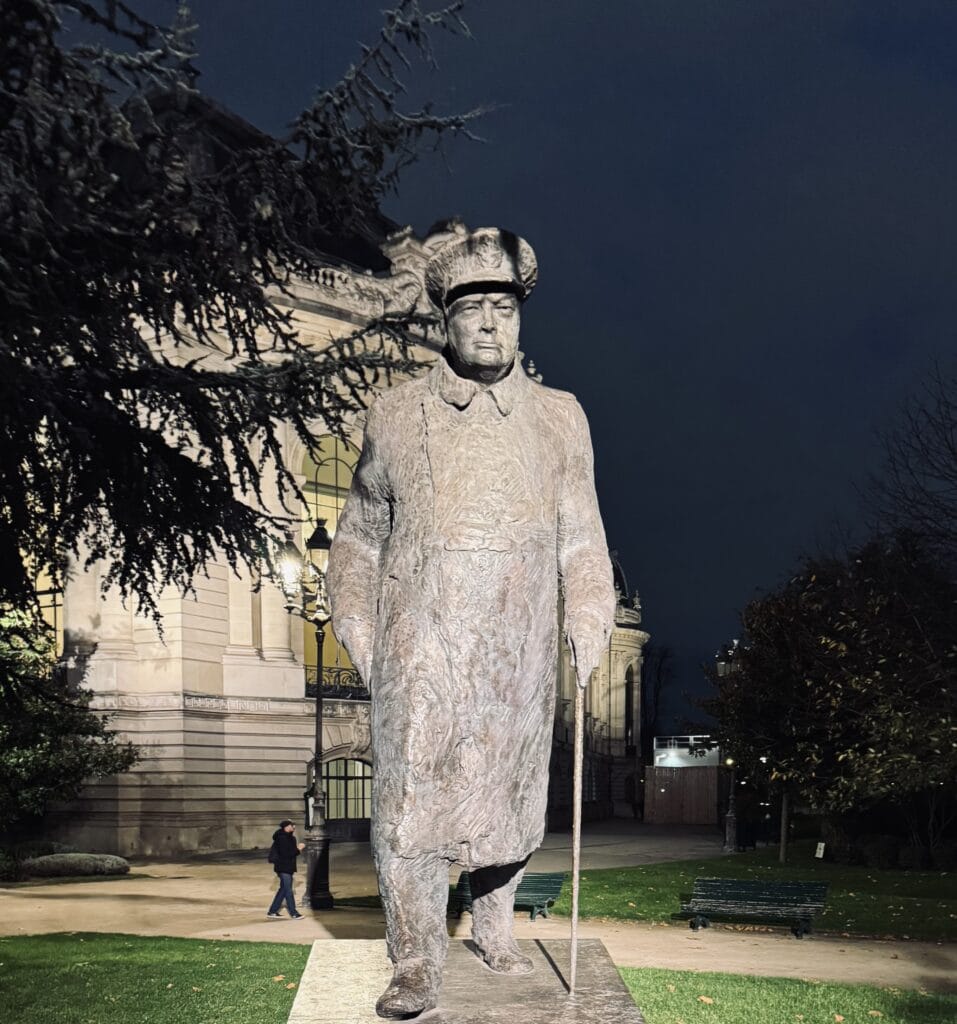
Winston Churchill sculpture in Paris by Jean Cardot 1998 (photo: Pieter 2025)
Notary Van Kerckhoven is an admirer of the courage of the former British prime minister Winston Churchill. The following sayings hang on the wall of his office: “We make a living by what we get… We make a life by what we give.” – Winston Churchill
“Audi, vidi, tace, si vis vivere in pace.” (Hear, see and keep silent, if you want to live in peace.)
The notariate dates from a time when computers did not exist and deeds had to be typed. Frie gets annoyed by typing errors and ‘collates’ (vérifier des textes, des actes) at lightning speed, marks them in pencil and gives the responsible clerk a dressing-down. Frie gets angry at the forbearance with which the thinkers behind the Dutch Language Union look on. Reading a French or German book from a hundred and fifty years ago is perfectly possible. In Dutch that is almost impossible. Frie likes to tell anecdotes, such as about a family meeting where one of the invitees failed to show up and about which the family did not want to say a word. The man was to come separately after 10 p.m. and turned out to be the early-released ship’s electrician ‘Dexter’, who had kidnapped and murdered Baron Bracht (1915-1978). (One of the most sensational ransom kidnappings in our country.) “He was a friendly man, though, you know”. Frie urges his clients to settle everything amicably to avoid lawyers’ fees. Every year the notary clerks and trainees with partners are invited to a dinner at the gourmet restaurant.
Because many people feel a threshold of reluctance to go to the notary, Frie organises information evenings in parish halls such as the hall den Abt in Wolfsdonk. The notary gives information on, for example, registered gifts to the children with retention of usufruct.
“L’amitié n’existe que par intérêt. Derrière chaque lien, il y a toujours un calcul caché.” – Godfried fully shares the view of La Rochefoucauld.
Frie tries to motivate Pieter for the notariate: he takes him to public sales in cafés and has him do odd jobs at the office. With that illusion in mind the notary’s office becomes a familiar place for Pieter and thus his morning routine. It is Monday morning, eight o’clock, the notary’s office in Aarschot has just opened. The postman delivers the mail personally to Godfried. Time is made for a short chat. Before New Year the postman gets a tip in an envelope. The social role a postman used to fulfil, which has now disappeared entirely, Godfried finds a pity. An important piece of social fabric has vanished whose undertone is that you must be able to take the time for it.
some of Pieter’s tasks:
Open the correspondence and distribute it among the clerks. Cut out and file the newspaper notices of public sales. “See that you don’t throw away the envelopes from the bundle of correspondence, boy. We can still use those for something else. And tear the letters in two. The unprinted part we can still use as scrap paper, can’t we.” – Frie
Errand boy: delivering or collecting documents at the registration and tax office, land registry, banks, post office, justice of the peace and fellow notaries. Typing addresses on envelopes, copying documents, sticking postage and tax stamps. “Stick them straight, boy, because otherwise it looks really sloppy.” – Frie
Setting out extra chairs for the family meetings, asking two neighbours to come and act as witnesses and compensating them for it. Pieter is present at the reading of the deeds and indicates where the signatures must go. Frie resolves interference by in-laws by showing them out with slamming doors. “Family quarrels always arise through in-laws. Schoolmasters, university professors and gendarmes, they’re the worst. You can’t tell them anything, those fellows know everything. You’d have to be a doctor of law as well. Everything revolves around women and money.” – Frie
Between 8.30 and 10 p.m. the office is closed. Godfried drives to Langdorp, pursued by stress. A revolver lies in the glove compartment of his car to defend himself. He is one of the few in Aarschot allowed to do so for that reason. Before opening the door of his car he turns back each time and checks that the door handle of the office is really locked. “With a lot of headaches” (worries), a slightly bent back and rheumatic deformities in hands and wrists. The rest of his body bravely resists fatigue. “It comes from sitting in that damp wood, that I have rheumatism, doesn’t it.” – Frie

“Les trois singes de la sagesse” stand in Godfried’s office
Passing on the torch
In 1998 Frie unexpectedly announces his departure: after 39 years of toil, the 68-year-old notary himself finds that his health no longer allows him to carry out his office. The ideal succession does not exist and many feel called to succeed Godfried, but who is the most capable? Frie personally ensures that Dirk Michiels is put forward as successor. Dirk continues “in the light of Godfried” but remains active himself too.
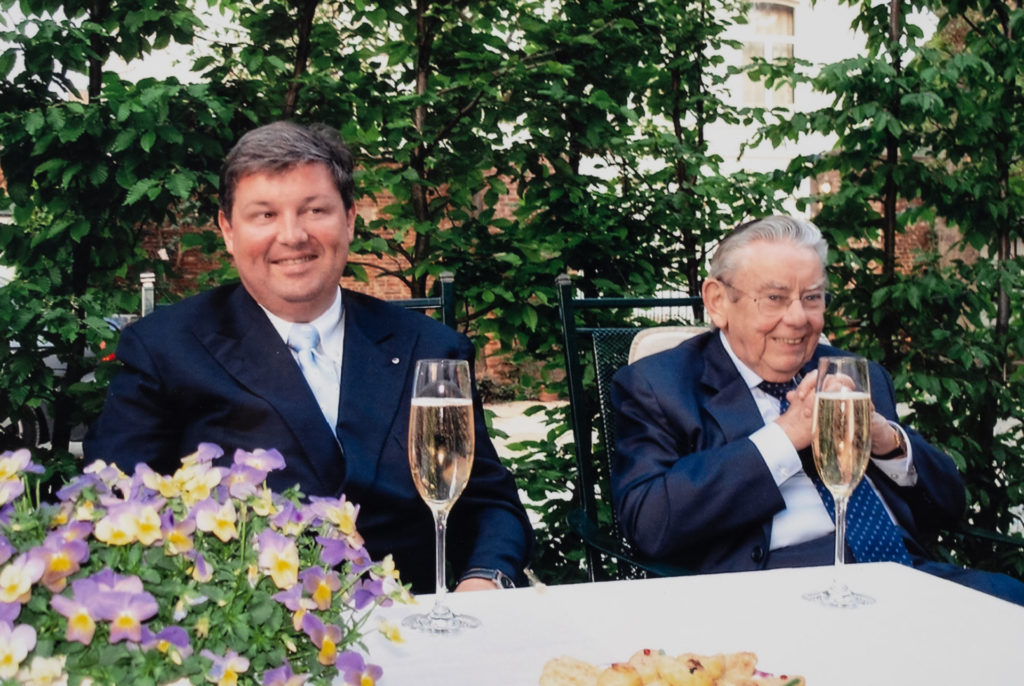
Notary Godfried speaks with praise of his favourite Dirk Michiels. (photo: 2007)
(2025) On the occasion of an exhibition in the Stedelijk Museum Aarschot, Laisse talks about Godfried and his sugar aunt Josse.
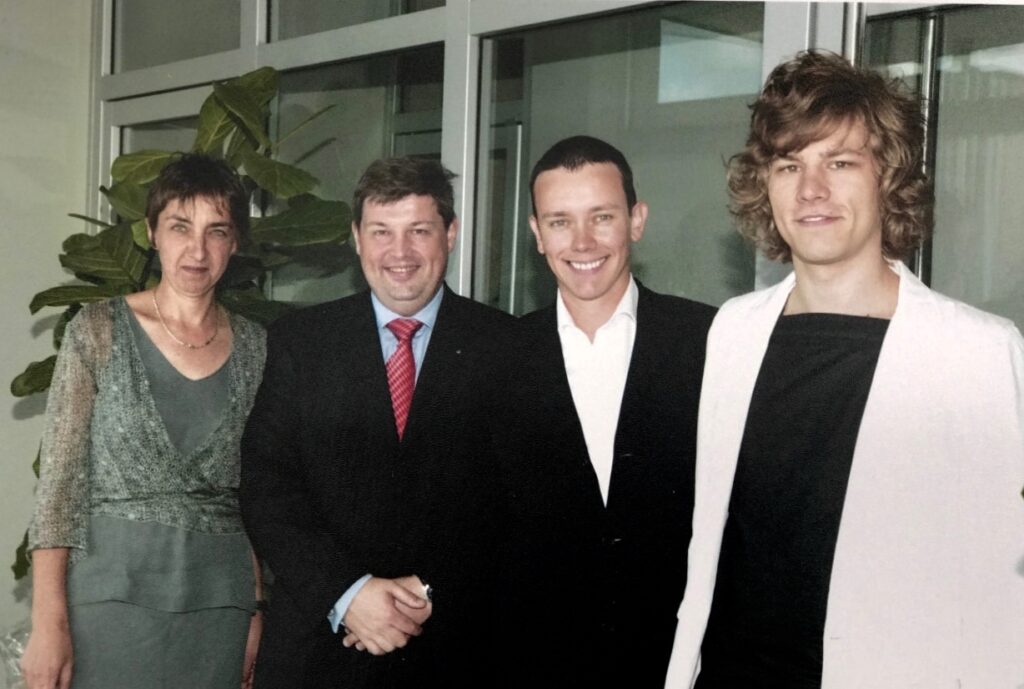
notary Lieve Stroeykens, notary Dirk Michiels, Pieter, Tim Goossens, Global Director of Academics and writer from New York (originally from Begijnendijk).
2022, from the VRT reportage series ‘Behind the scenes at the notary’, in which a number of active and retired notaries are interviewed and followed. … Notaries now sell via the online auction platform Biddit. “That public sale was, if we are honest, no longer of this time”, says notary Dirk Michiels. “Who is going to take a day or half a day off to go and sit in a café, only to not even be sure you can buy the house, and sometimes for two afternoons in a row?” Honorary notary Guillaume Roberti de Winghe – the seventh and last generation of a family of notaries that began in 1783 – does not follow that reasoning. “I liked doing that, those public sales. Especially in the café in the villages and so on. You see the people and you know who you are selling to. Through digitalisation it is precisely that human aspect that is lost.” …
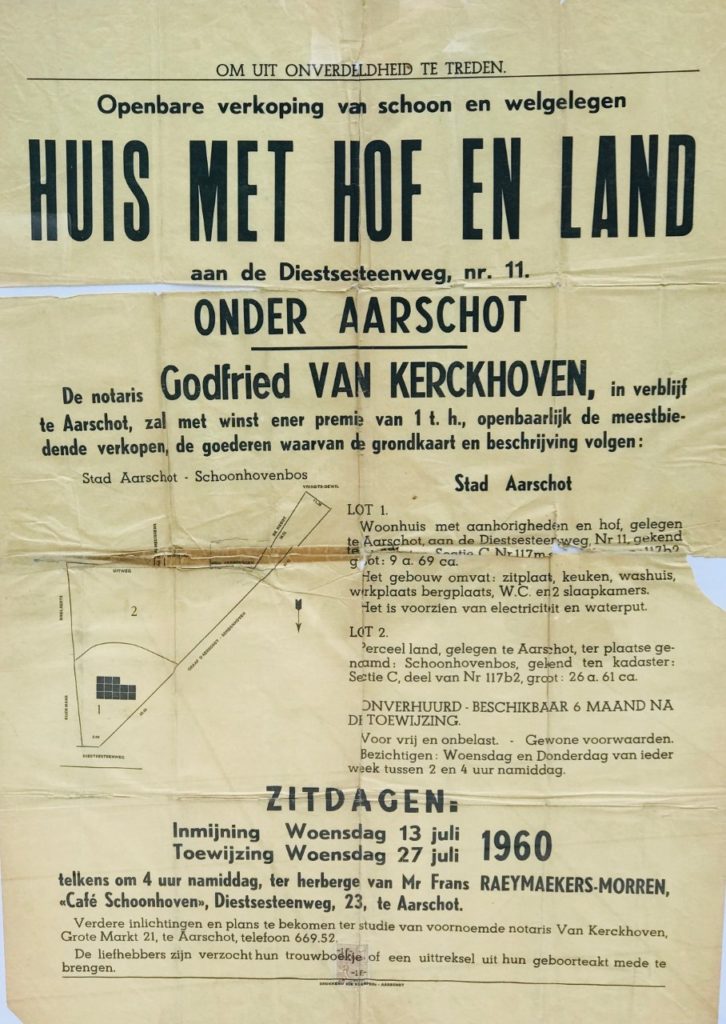
“A public sale in a café; that is what I like doing best.” – Godfried To the horror of his confrères (this is how Godfried always addresses fellow notaries), Van Kerckhoven begins to give “rounds of drinks” during public sales. Frie turns it into a one-man show. If, according to the famous notary, not enough is being bid, he starts to ham it up. Godfried, with his powerful voice, to the publican: “Give them all something more to drink!” In this way his public sales become notorious in Aarschot and surroundings. Wherever notary Godfried arrives the cafés are packed. It gives him great satisfaction. ‘The notary’ lets rip: “And you all come and sit here so you can drink at my expense!” The café patrons roar with laughter, there is a lot of chuckling. The walls of the waiting room of Godfried’s notary’s office are completely covered with yellow posters of the public sales.
TEXT BY NOTARY LIEVE STROEYKENS
… Both notary Michiels and I are proud that we were able to succeed notary Godfried Van Kerckhoven, and we are grateful that for so many years after our appointment as notaries in Aarschot we stayed in regular contact with notary Van Kerckhoven and enjoyed his company and the anecdotes he told us from his notarial life.
Every month notary Van Kerckhoven came with us to Leuven, to the notaries’ house, to see his former colleagues, notaries and honorary notaries once more on the occasion of the study circle. There too he was a very welcome person because of his interest in everyone.
He often dropped by the office to chat with his former colleagues and to look in wonder at all those new faces.
I went to the office to look at all the deeds that notary Van Kerckhoven signed and that stand bound in our library as witnesses of a rich professional life, a life of hard work and a story of commitment to many people!
The story begins with a specification of conditions and a record of award, a public sale on 15 October 1959, still signed then as Master Godfried Van Kerckhoven, notary in Aarschot, doctor of law. It is a sale at the request of the Commission for Public Assistance of the City of Aarschot, written by hand in blue ink on five pages.
On 24 August 1998 he signs his last deed, which is now typed with a word processor and much longer. It is deed number 40,036; the last time we saw him he told me how he had asked the postman to come a little later than usual that day with the registered letters, so that just before his resignation he could still close a difficult liquidation in which he had been judicially appointed.
It typifies the great man that notary Godfried Van Kerckhoven was, it testifies to his respect for clients and colleagues, to his drive to look after people. He was a true family notary, he did not live like a hermit in the woods of Langdorp! He was active in various associations, he knew everyone, whole families, with their children, their grandchildren, their stories, their sorrows and their happiness. Even now I often hear from clients how amazed they were that he still recognised them after years and still knew why they had come to him back then …
He was a modest man, but a great citizen.
Lieve Stroeyken, notary (2013)

Godfried (photo: 1987)
Interview on the occasion of the retirement of clerk Gaston Weckx.