°1958
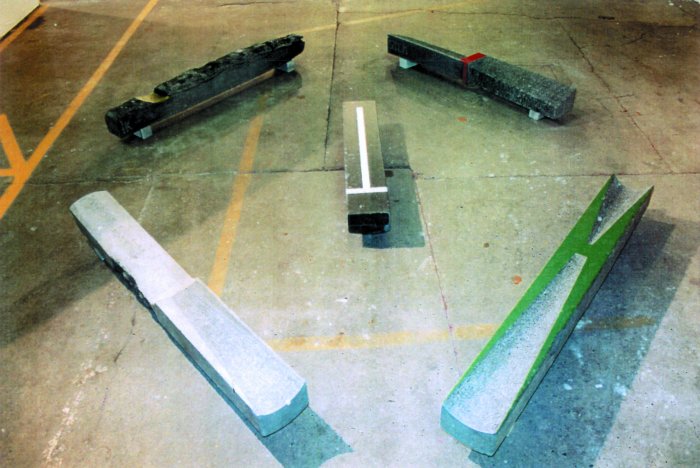
Environmental creation “Home” (2001)
- 5 x blue limestone – 1 x 1.50 m – 1 x 2.00 m – 3 x 2.20 m.
- Arrangement: 5/5 m.
“Patiently waiting for the voice that makes the bond”?
HOME, knowing oneself at one’s origin,
Not uprooted, nor displaced;
Across all borders it must nonetheless
Imply a general well-being.
What of a voice in exile, a lost one?
What of the “unheard”?
I saw, felt and would hear many voids.
A voice, regardless of the position, language and sound
it expresses, cannot simply be any voice.
It is just as much a bundle, of equal worth.
Voice and hearing (with all gradations and nuances)
Tuning them to each other is like finding a home (living together, being together)
much closer.
Dedicated to all the homeless.
— Solange Janssens
Solange Janssens, born in Aarschot in 1958. Studied sculpture at the RHDK in Brussels and at the Academy of Fine Arts in Anderlecht.
Work in the possession of the National Bank of Belgium.
Solange Janssens is an artist of her own speech.
She is doubly talented, for she writes poetry and carves sculptures. In Solange Janssens, both art forms are intimately interwoven and as such inseparable.
“Home” (Thuis) is a sculpture with a multi-part symbolic layering.
First there is the choice of the hard material, blue limestone, chosen for its stubbornness, durability and austerity.
Also important is the fact that the basic sculptural elements – measure, volume, weight, form, working, space and place – are accentuated and are thus an important element in the visual and mental experience of the artwork.
Furthermore, the natural colour of the stone is interrupted by manually applied colour accents – yellow, green, blue, red and neutral grey – which, alternating, can be interpreted as aesthetic as well as mystically charged signs.
The poetic carrying power of the sculptural environment is borne by the carved contribution on the side of each element of a number of word concepts: T’Horen, Uniek, Ik and Stem (Dutch for “to hear”, “unique”, “I” and “voice”). Together their first letters form the new Dutch word “Thuis”.
Knowing that half of the world’s population currently leads an unwanted nomadic existence, the word “Thuis” takes on a symbol-laden meaning that each of us can interpret in a personal way.
The artist Solange thus succeeds in a highly original way, with her environmental creation “Thuis”, in fusing word and image into a coherent whole and in actively involving the viewer in the interpretation of the artwork
— Octave Scheire, art historian