Memories of Fons Brems
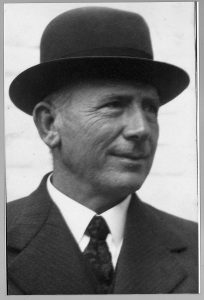
“Our Grandpa Brems lived from the mid-1930s in his newly built house at number 188 Leuvensesteenweg in Aarschot, next to the house of his son Jozef, which had been built a year earlier. As the eldest daughter of “Jef”, a toddler of 3 or 4, I, Yolande, was fascinated by my grandfather’s activities; here I try to bring back my earliest memories of that time.
His house was a corner house, surrounded by a flower garden that excelled in its splendour of colour and that at the back gave way to a herb, vegetable and fruit garden; behind it you looked out over a still unspoilt, wildly overgrown hilly landscape, an abundance of green.
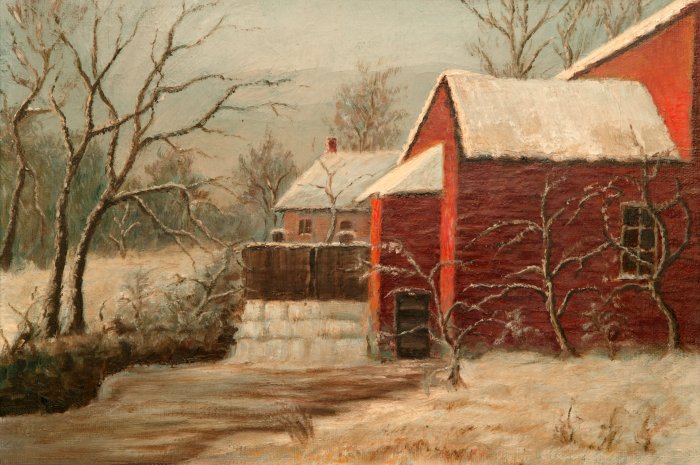
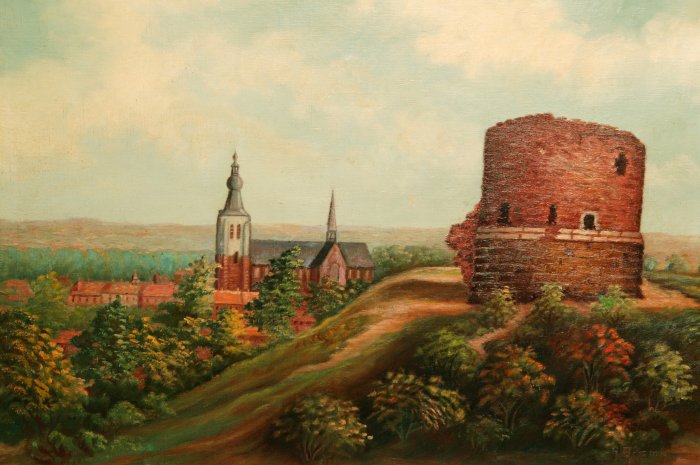
In that setting he painted, drew, gardened, read and now and then played his transverse flute. His studio was in the middle of the house, with a window to the east and the south. In that studio were all his painting supplies, a desk and a large cupboard crammed with books. A self-made man, well versed in literature, science, history, art and philosophy, he could provide information on any subject.
As a small child I very often sat next to him, he at his big easel and I at a small one, trying to imitate him as well as I could. Sometimes he asked me to look at his subject through my hollow fist, and as a small child I would give my opinion, for example: “Grandpa, a little more white there, because it’s rather dark”. He would then say to my parents: “and that child is right, too”.
He worked in all seriousness and with great concentration, and then it had to be dead quiet around him, but he could also be very humorous and cheerful and laugh heartily, and that over simple things such as an enormous gift wrapping from which came a tiny little box with a single chocolate; then it was “and in that box is another box and another box etc.”; he could also roar with laughter at humorous reading. As travelling railway staff, he was a head train conductor, he retired at the age of 55 and could fill all his days with his hobbies.
The last 30 years were therefore very productive painting years.
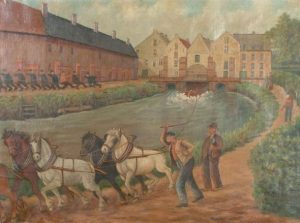
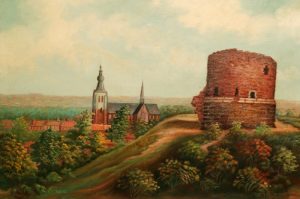
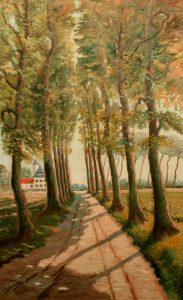
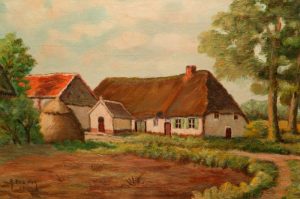
His paintings, to which he devoted an enormous amount of time and care each time, were very successful. I remember that he received many visitors who came to look, to buy or to order. People loved his work, but also admired his flowers. In tulip season all the tulips were counted and drew much attention. If passing children picked one, they immediately got a serious scolding.
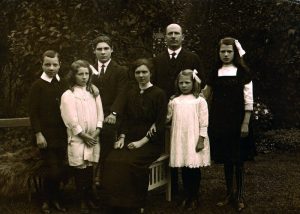
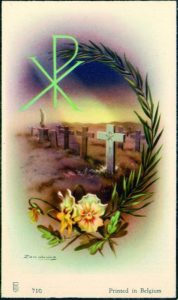
During the First World War the family of Fons Brems (5 children) had moved away for a few years to England, to Birmingham. In the last year of the war, however, he received an assignment with the railways in France, in Elbeuf. The whole family was thus able to express itself well in English and French. The Second World War shook everything up, the family had fled here and there; the fact is that Grandpa was in his house during one of the heaviest bombardments of Aarschot; he had fled into the cellar and clung to a pillar with a bottle of wine in his hand, which he drank down to the last drop. Afterwards people found him half unconscious next to his bottle in the Papenakker, glad that he was still alive. The war years put all activities on the back burner. The beautiful flower garden turned into a potato field, and repairs had to be made to the house. Yet he took up painting again. In summer Grandpa went swimming with his son Jef (my dad) in the Demer at Nieuwland, and during the cold winter months the two went skating on the ponds of Gilmont, where we children also had a great time. Listening to the “English radio” was a dangerous but fascinating new hobby for our Grandpa. In religious matters he definitely had a mind of his own, having worked through just about every possible theology. He did believe in something supernatural, something intangible, but could not reconcile himself with hypocrisy. When around Easter a lady came to the house with flowers to decorate the crucifix and remarked: “Your newspaper does not go with the crucifix”, Grandpa promptly took the crucifix, which by tradition hung on the wall above the mantelpiece, off its hook and hid it, whereupon the lady left and never showed up again.
Someone who dared to go against the prevailing church rules of belief was a rebel in those days, like the writer Cyriel Buysse, whose books were banned by the Church. Grandpa admired him and painted his portrait; my mother wondered: “why is Grandpa painting the devil now?” He was liberal in outlook and so every year we went to the Christmas party at the “Cirkel”, where I then performed in the song programme.
In 1941 the state secondary school of Aarschot was opened to girls; Grandpa Brems and my dad were great supporters, since there were no opportunities for girls to continue studying locally after primary school. Grandpa then helped found the alumni association, of which my dad later became chairman.
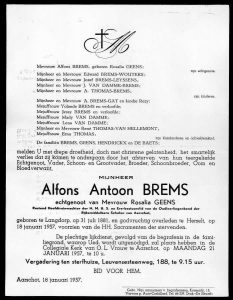
After the last war a great deal again had to be repaired in the houses. They had also been requisitioned by soldiers while the family was still on the run and even after its return, because we all had to make do with the back house while they occupied the front. The repairs demanded much of Grandpa’s energy and strength. He still painted until 1953. Then he was struck down by a stroke, which he tried to overcome until, in 1957 on a very cold day, he left his house and all his works for good.” – Yolande Brems, granddaughter