Jacques Van den Seylbergh (1884-1960)
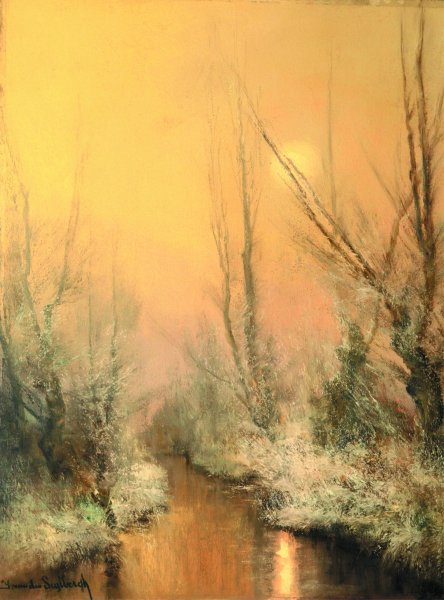
De Motte
oil on canvas, 80 x 90 cm
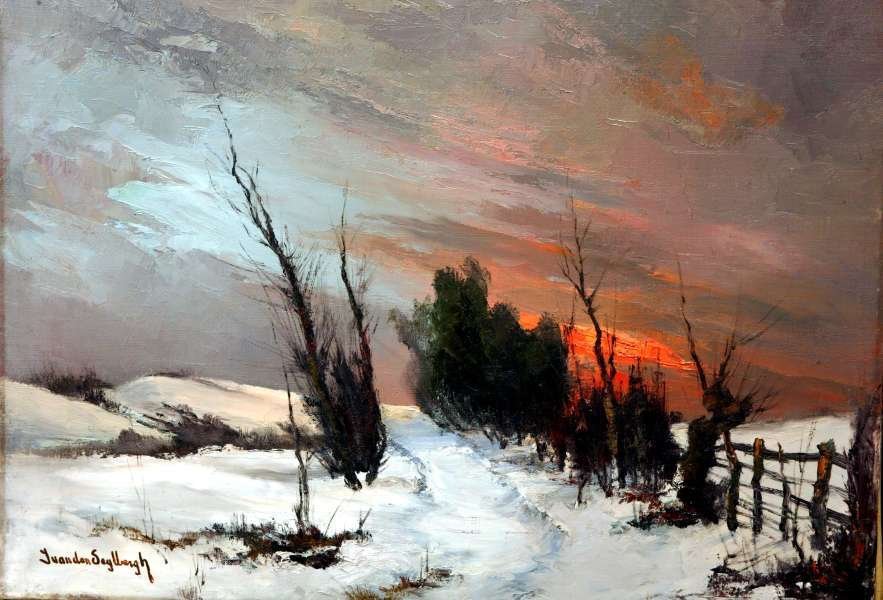
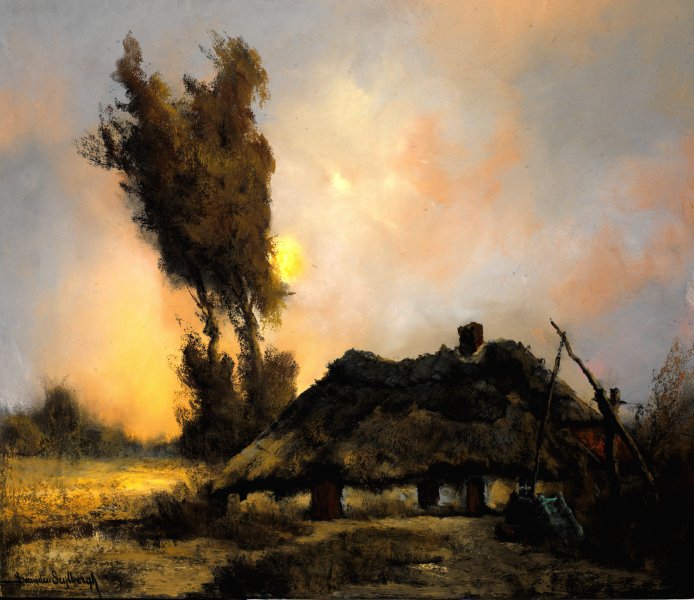
Hut in the Kempen
pastel
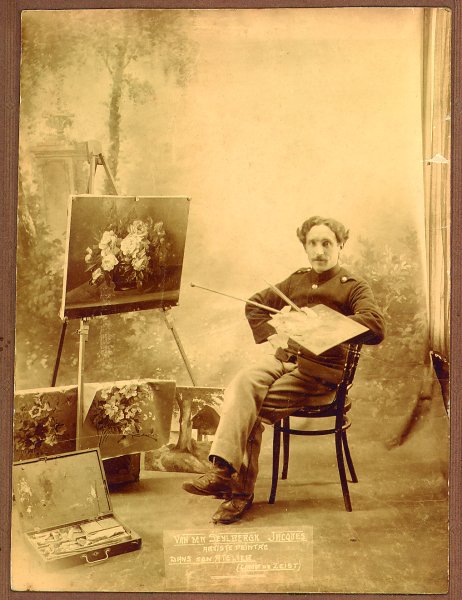
Jacques Van den Seylbergh in his studio at the Zeist camp
“It is a greater art to live richly than to be rich.“
Jacques Van den Seylbergh
Jacques Van den Seylbergh began his artistic training in 1898 at the drawing school in Geel. From 1904 he is found enrolled at the Antwerp Academy of Fine Arts. He later perfected his skills in The Hague and, as far as pastel painting is concerned, in Paris.
In 1913 he married Josephine De Meyer. In 1921 they came to live in Aarschot, in the Art Nouveau house Begijnhof, number 2.
It was also in this period that his contacts with other artists became more numerous and that he became friends with James Ensor, among others. It was thennot unusual for half a dozen artist friends to gather at his home and for them to discuss for hours a particular colour that was to be used.
Around 1936 he had a villa built, modern for its time, on the corner of the Elisabethlaan and the R. Wetzstraat. During his time in Aarschot he painted Hageland landscapes, town views and village views. Jaak captured the then still unspoilt beauty of our region.
This native of Aarschot was regarded as one of the best pastel artists in Europe, if not the best. Works by him can be found in the United States, Canada, India, as well as with the Swedish royal family. In 1960 Jacques died of a heart condition in his villa “La Charouppe” on the Astridlaan in Knokke-Zoute, where he was known as the painter of the Zwin.
source : ………………………………
- Painter, pastellist, miniaturist. Trained at the Academy in Antwerp. Preference for, among other things, views of the Zwin, the Ardennes, but above all Kempen landscapes with low horizons and sombre cloud banks, flowers, interiors. He sought above all to create atmosphere and airiness in his works; mist, haze and hazy horizons play an important role in this.
Mentioned in BAS III (Belgian Artists Signatures) . source : Paul Piron – De Belgische beeldende kunstenaars
- (…) J. Van den Seylbergh is a virtuoso, yet he is best enjoyed when he remains simple, both in his means of expression and in his choice of subject. Exceptionally calm, and at times of a dreaminess that does not leave one indifferent, are a few winter landscapes, marshes, birches. (…) Het Laatste Nieuws, 1948
- (…) His winter landscapes are unique and truly evoke in the viewer the mood of the desolation of our Kempen and the harsh winter. (…) De Standaard, 8 November 1955
- (…) He developed a technique of his own: an impasto pastel, which he handles masterfully in a great number of shades.(…) De Standaard, 17 January 1958
text by Philippe Vienne:
Painter and pastellist born in Antwerp on 6 March 1884, died in Knokke on 11 August 1960. Posthumous son of Louis Van den Seylberg, a carpenter of Dutch nationality, and Maria-Theresia Van Eynde, originally from Geel.
A problem arises regarding the exact spelling of his name: the artist signed “J. van den Seylbergh” and was very attached to this spelling. However, the official documents, including his birth certificate, bear the entry “Van den Seylberg”, a name still borne by his descendants.
The formative years
Having never known his father, Jacques Van den Seylberg was raised in Geel by his mother’s family. After completing the lower level of his secondary humanities, he enrolled in 1898 at the Drawing School of Geel, where he was a pupil of the first director of that institution, Jan-Baptist Stessens. In 1904 he enrolled at the Academy of Fine Arts in Antwerp, where he was taught by Henri Houben with whom he would remain in contact. The following year he opted for Belgian nationality.
On 6 September 1913, Jacques Van den Seylberg married Josephina-Maria De Meyer, from Noorderwijk, near Herentals. When war broke out, he was mobilised and went with his regiment to the Netherlands, where he was interned in the Zeist camp, near Utrecht. Inside the camp he had his own studio and engaged, among other things, in restoring local works. He seems to have enjoyed a certain freedom there and to have been able to meet his wife. Indeed, a daughter was born to them on 1 October 1918.
Maturity
After the war, back in Belgium, he first settled in Westerlo, then, from 1921, in Aarschot, where he carried out, among other things, the restoration of The Adoration of the Magi by Gaspard De Crayer, damaged in the fire of the Church of Our Lady in August 1914. From 1924 to 1940 his artistic output was considerable, as was the number of exhibitions in which he took part. It was during the same period that he became friends with various artists, including James Ensor and Firmin Baes.
When the Second World War broke out, Van den Seylberg fled to the south of France; in the summer of 1940 he exhibited in the Ardèche, at Annonay. Back in Belgium in 1941, he settled this time in Kessel-Lo and then, in 1943, in Spa, where he was officially resident from 1948. He exhibited there several times (at the inn La Vieille France, at the Casino and at the architect Armand Micha’s). In 1950 he left Spa for Knokke, where a friend rented him a newly built villa (“La Garoupe“). He died there on 11 August 1960.
Jacques Van den Seylberg exhibited all over Belgium (Antwerp, Bruges, Brussels, Ghent, Ostend, Spa,…) but also abroad (Amsterdam, Rotterdam, Madrid, Cardiff,…). His works were also acquired by a cosmopolitan clientele spread throughout Europe (the Swedish royal family is among his clients), America and Asia. It nevertheless took more than twenty-five years after his death for a retrospective to be devoted to him, in Aarschot, in 1988.
A painter of nature
In his work as a whole, pastel occupies the predominant place, even if there are a few oil paintings and miniatures, to which should be added the restoration work, still poorly known. With a few exceptions, Van den Seylberg’s works are not dated, which makes it impossible to establish a chronology and hence a stylistic development.
But ultimately this matters little, because his work is homogeneous, almost exclusively devoted to nature. The nostalgic landscapes of the Zwin, the Kempen and the High Fens occupy a large place in it, alongside sober bouquets of flowers, peonies in particular. Besides obvious qualities as a draughtsman and colourist, Van den Seylberg shows such sensitivity that one can conclude, with Eugène De Seyn, “that he paints as a poet“.
Philippe Vienne