Fons Goossens
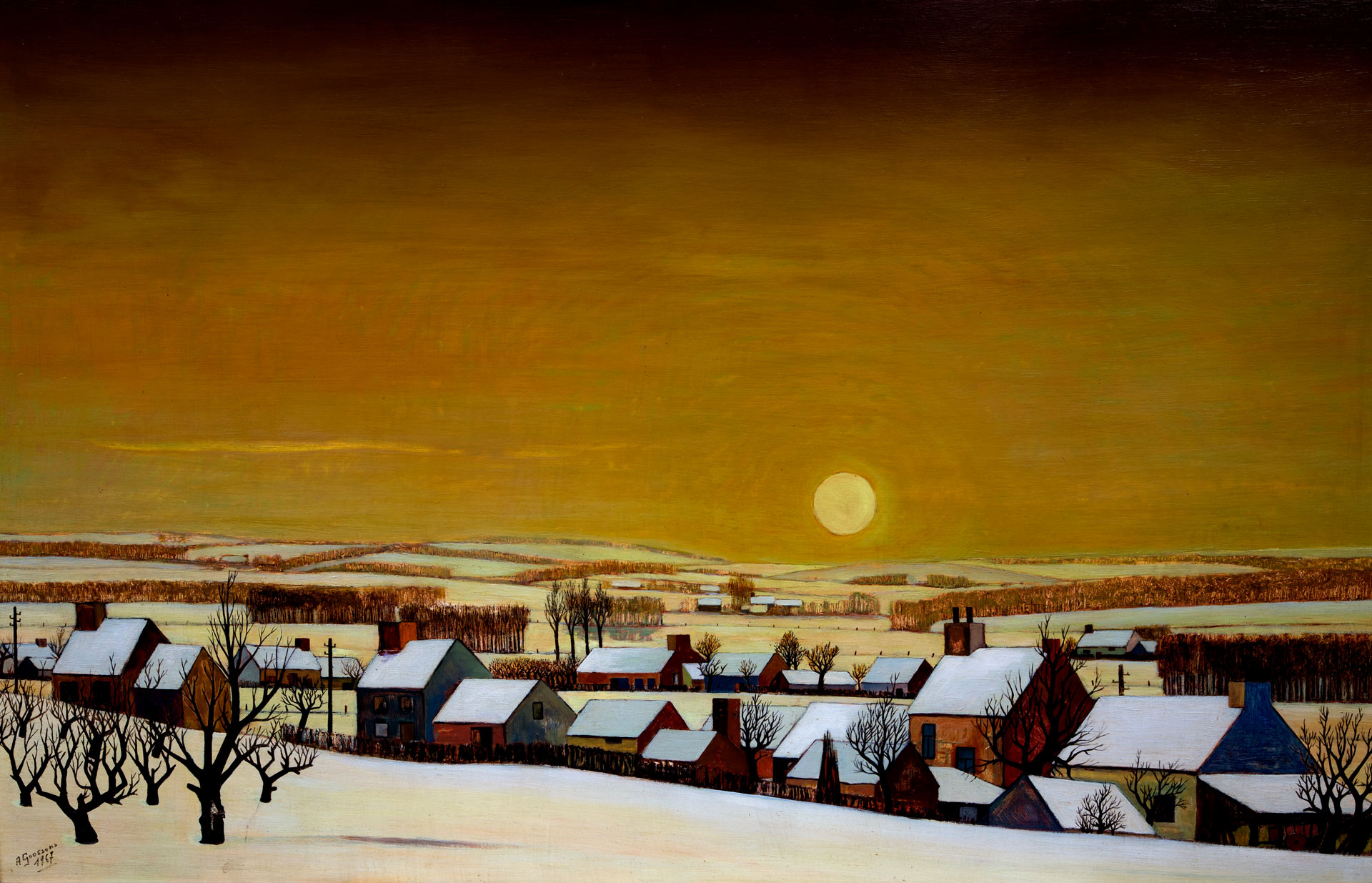
82 x 126 cm
1967
oil on panel
Winter morning.
For Fons the landscape is a symbol of the infinite,a timeless space, covered in winter with a great white blanket that merges with the sky on the horizon.
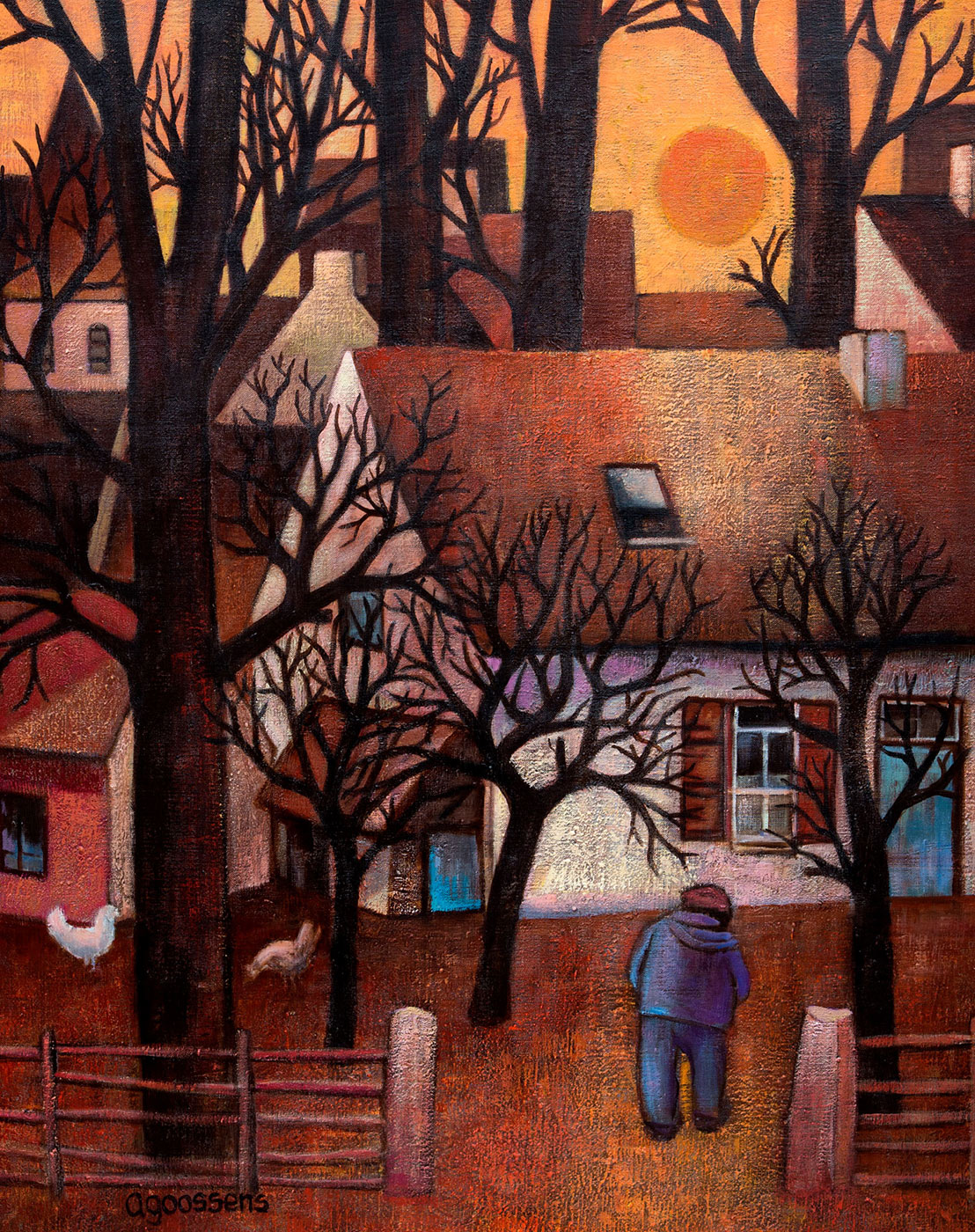
100 x 80 cm
acrylic on canvas
The old farmer.
Alone, in the glow of the evening sun,
he shuffles across his yard.
Tall trees surround his whitewashed farmstead.
This man has lived here for an eternity, here he has his roots.
Here he will die in all simplicity.
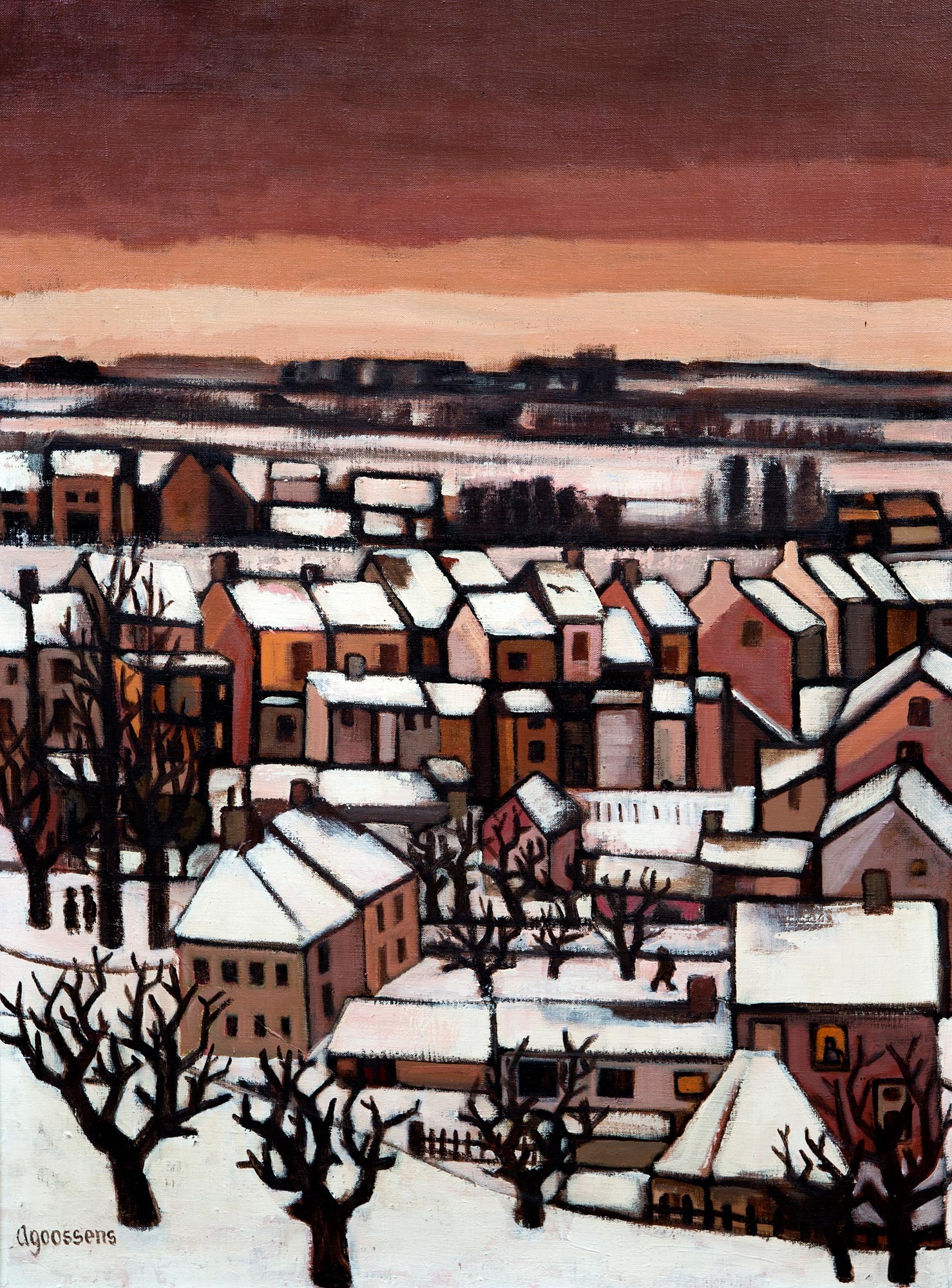
80 x 60 cm
acrylic on canvas
Suburb in the snow.
A soft layer of snow covers the monotonous houses.
Bare, gnarled trees defy the severe frost like sentinels.
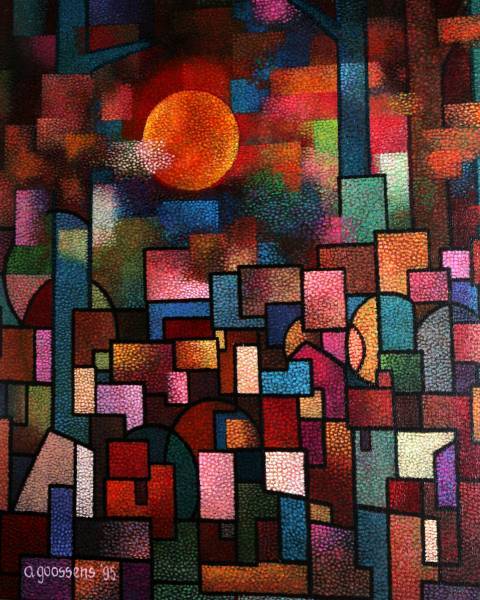
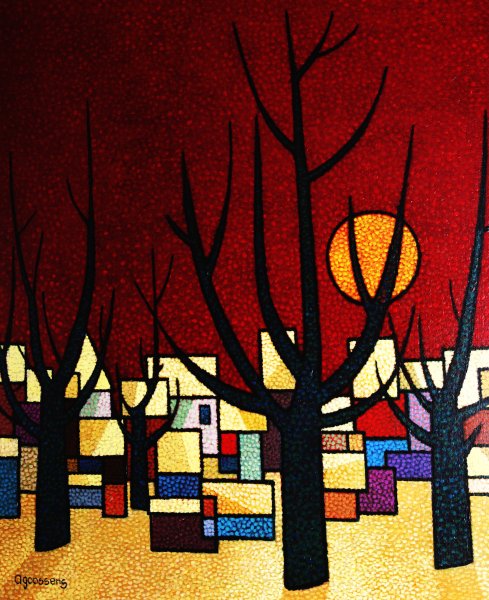
90 x 80 cm
1995
Autumn.
acrylic on canvas
The landscape is greatly simplified,
to the edge of the abstract.
The houses pile up into autumnal planes.
The late autumn becomes a feast of colour
with shades of orange-yellow,
merging into red and brown.
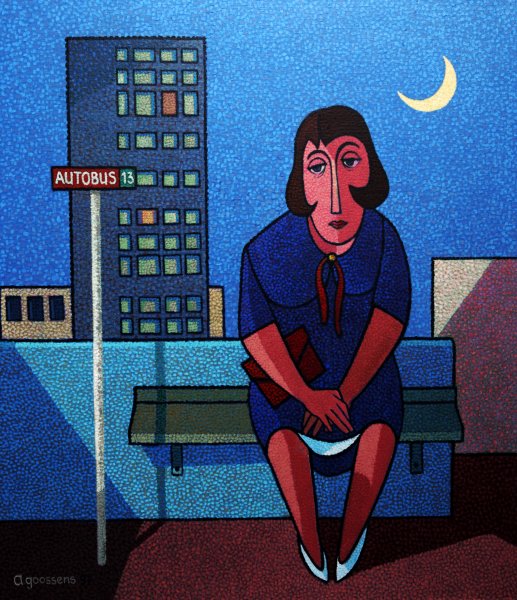
80 x 70 cm
Stefke.
acrylic on canvas
Patiently and resignedly she waits… How long?
She herself perhaps does not know.
By placing this figure in a desolate environment,
the painter emphasises her loneliness.
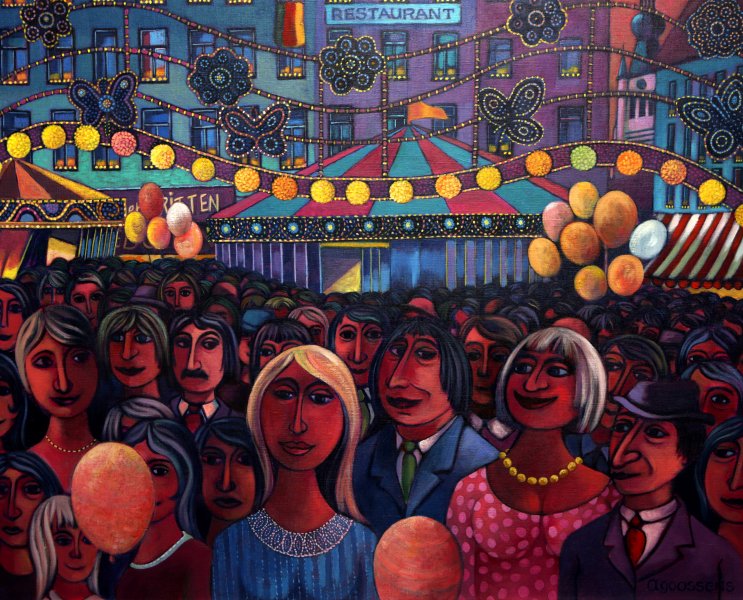
80 x 100 cm
Aarschot fair.
acrylic on canvas
A tanned crowd walks through the town,
enjoying the convivial festival.
Unlike at a demonstration,
the spectator here stands before the masses,
who, dressed up for the occasion,
stroll contentedly through the streets.
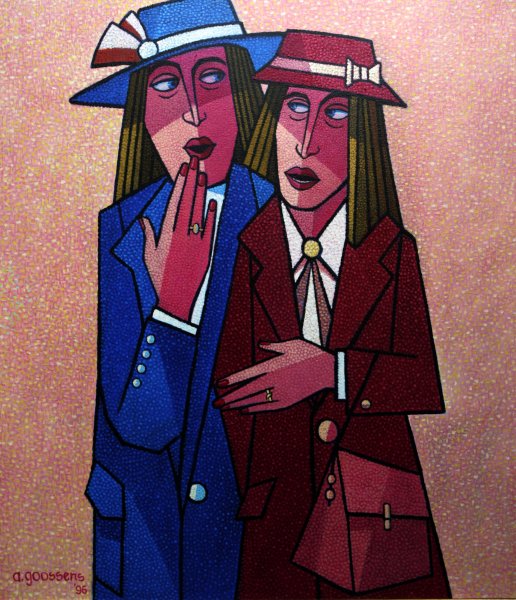
80 x 70 cm
1996
Anne and Suzanne.
acrylic on canvas
Two distinguished, talkative ladies.
Starting from a sketch from nature, the whole is here
simplified through taut lines to the essence:
the depiction of gossip and backbiting.
Fons Goossens was born in Langdorp on 24 March 1932 in a family of three children. At the age of 25 he married Paula Luyten. Together they have two children, Raf and Christel, and five grandchildren.
As a small boy he romped about in the open countryside: the recreation of children “in the country”. Toys were scarce, certainly in the war years, but pencil and paper could always be found somewhere.
Fons liked to draw. Even in the margins of his textbooks he made funny doodles.
One day he happened to meet Juul Van Gaubergen, a painter from the Aarschot area. He showed him not only his own works but also books about the Latem school. He told him about Permeke, Gust De Smet, Servaes and De Saedeleer, who could paint endless vistas, almost like ours in the Demer valley.
That was when his interest in painting was truly awakened. Fons Goossens visited all the exhibitions in the area, sought contact with painters and enrolled at the drawing academy of Aarschot. His young teacher, Maurice Haccuria, advised him to develop further in art.
At the age of seventeen he left the college, but continued to work at the academy. Every free moment he sat in his attic room drawing and painting. For friends it became a welcome meeting place. Lively conversations were held, discussions about paintings sometimes ran high, but there was also a lot of laughter.
Above all with his friend Warre Van Rompuy, who would later become a stained-glass artist, he often went out into nature. Even in bad weather they sometimes sat outside working under an umbrella. “To be able to paint the cold, you have to feel the cold,” said Warre. And Fons agreed: only what you truly experience can you paint with feeling.
In 1952 Fons Goossens was called up for military service: almost two years unable to paint or draw, that was a disaster. Fortunately, after the first year he received permission to follow classes at the art academy in Antwerp. He studied life drawing, art history, projection and perspective. To cover his expenses and lead a comfortable life, he sold his drawings by auction to officers and soldiers.
After his military service he took another year of classes in Antwerp and then enrolled in an evening course at the art academy in Leuven.
Fons Goossens began to realise, however, that he could not survive without a decent living.
He made posters and advertising leaflets and went to present them to firms in the hope of winning a commission.
At an exhibition of religious art in Averbode, Fons Goossens met the writer Yvonne Waegemans. He asked her whether he could illustrate a children’s book free of charge. With this book as proof of his ability, he approached various publishers. In this way he ended up at the Averbode publishing house, where he received a few odd commissions.
One day he met his former teacher Maurice Haccuria. He managed to convince Fons Goossens that graphic designer was a profession with a future, and one that moreover was closely related to his artistic training.
But there was no proper training for it. In addition, one had to be familiar with the various printing techniques.
At the Altiora printing house in Averbode, Fons Goossens became acquainted with the various preparatory stages of printing work.
In the evenings he often drew and painted until deep into the night.
Just when Fons Goossens wanted to leave Altiora, a competitive examination for graphic designer was announced. He took part, with the result that the publishing house asked him to do the layout for three French-language magazines.
In 1973 the new magazine “Top” appeared. A layout drawing office was set up, which he headed. Because working for four magazines greatly restricted his creativity, after ten years he decided to work only for the magazine “Top”.
For the publishing house he designed covers of children’s books and religious works, and for the Altiora printing house Alfons Goossens made advertising leaflets, catalogues and logos. But painting remained his great passion: tension in relaxation. Now that his free time is almost unlimited, he can disappear into his studio at any moment to let himself go in drawing and painting.
Lut Debroey
Fons Goossens, painter of discreet elegance.
Fons Goossens was born in Langdorp.
Studies at the Academy of Antwerp and Leuven.
From 1950 on, off he goes across fields and villages, drawing and producing admirable paintings. I say admirable, for this young artist – and this is becoming rare – manages to combine elegance, in its finest form: discretion, with an astonishing strength.
Hence the balance that emerges from these paintings, handled in a whole range from bright yellow to the deepest browns by way of marvellous orange shades.
Alfons Goossens is a new Permeke tempered with the grace of a Van de Woestijne and structured, built, constructed with the rigour of an architect. An architect of forms, of perspective, of volumes.
Finally, the young artist knows how to draw: he has a firm, clean, robust line.
– Jo Gérard, Historian
Extract from an article in “La Semaine” of 1 December 1967