Maurice Haccuria
100 x 80 cm
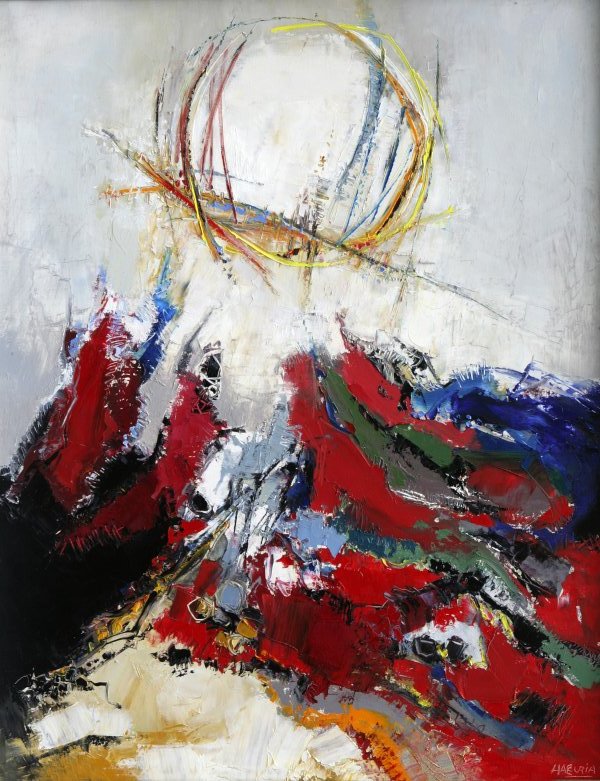
Growing towards the sun
oil on canvas
The sun is central. The circle that dominates the chaos, the search between earth and sky, between the horizontal and the vertical.
100 x 100 cm
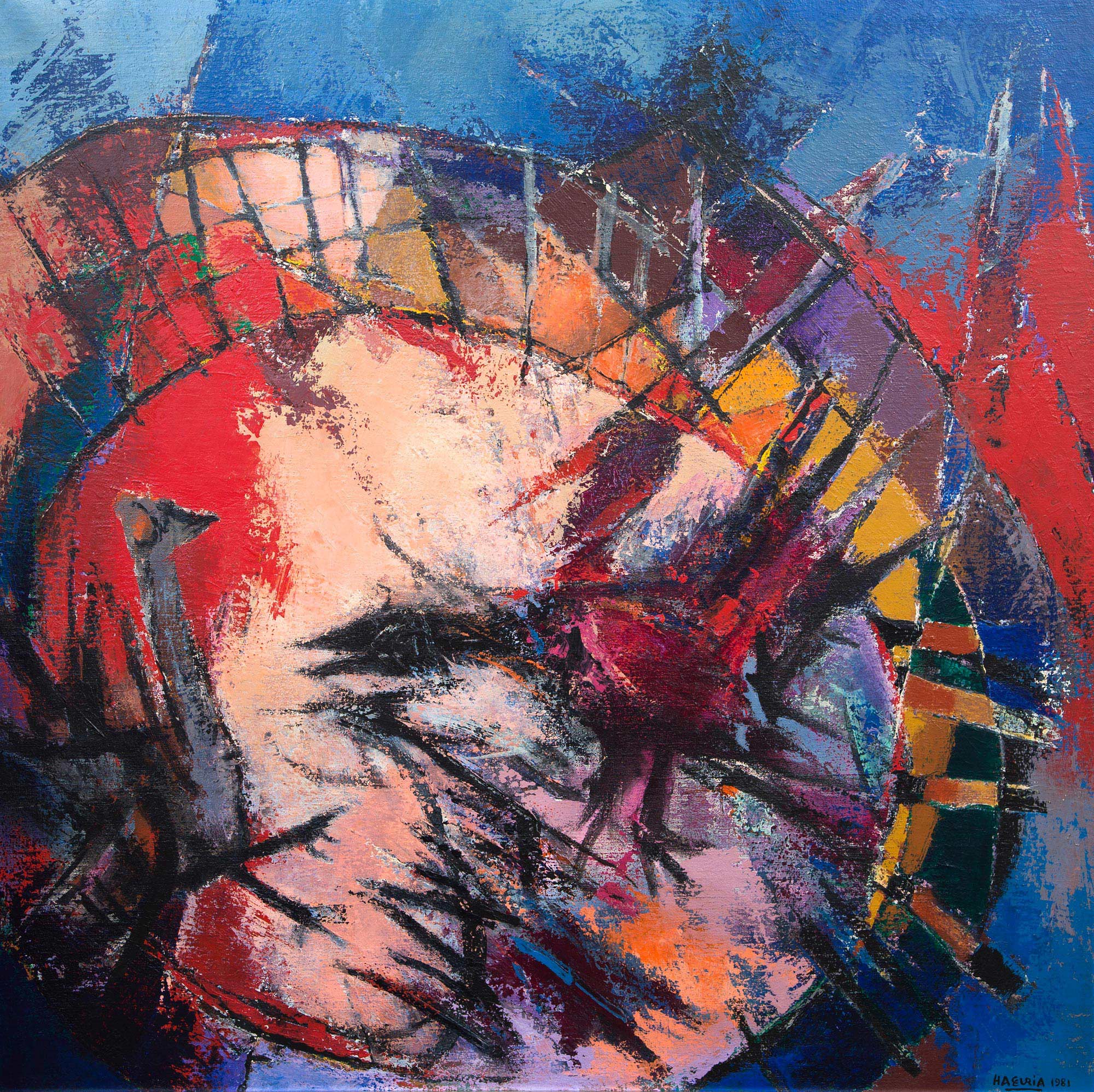
Birds in the universe
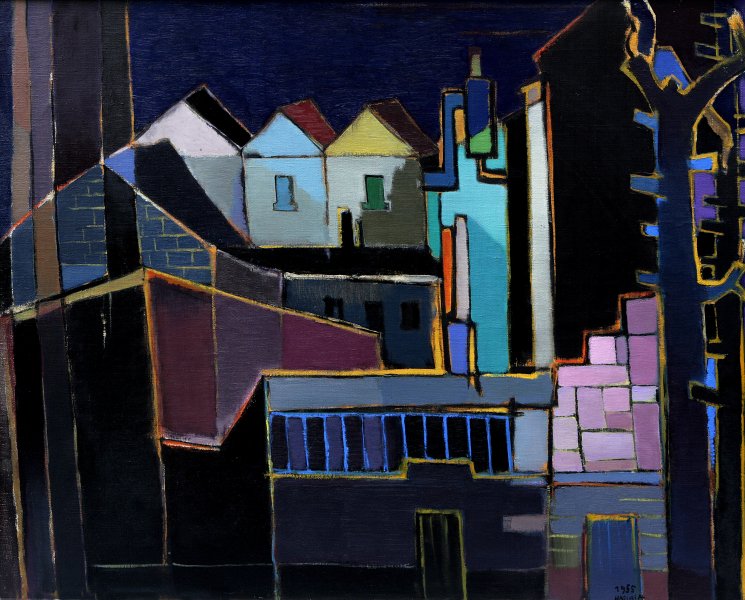
’s Hertogenmolens
acrylic on canvas
Haccuria starts from reality but creates an image of his own through contrasting tonalities on the colour planes, through the geometric play of lines and through the addition of an element that he cannot see from his vantage point but knows is there.
One of the largest watermills in Europe, in Aarschot.

110 x 80 cm
1975
Cheerful morning
acrylic on canvas

acrylic on canvas

120 x 165 cm
1965
Protest
acrylic on canvas

150 x 200 cm
1980
Four Horsemen of the Apocalypse
acrylic on canvas
For Haccuria, the technical conquest of the universe was an event for discovering space and time.

acrylic on canvas

100 x 80 cm
1977
Marriage of water and air
oil on canvas

150 x 160 cm
1987
Car graveyard
acrylic on canvas

120 x 100 cm
1987
Marina Sarzana
Sarzana is a town in the northern Italian region of Liguria.
acrylic on canvas


150 x 100 cm
1956
City quarter
From his living room on the first floor at Amerstraat 143, Haccuria looks onto the back of rebuilt houses of the beguinage destroyed in the Second World War.
acrylic on canvas

Reverse of this painting:


From 1976 to 1988 Haccuria travelled to Carrara for marble. Rough white marble blocks became soft sculptures that bear witness to controlled strength and poetry.
- ” Une statue en quoi? demanda Tristouse. En marbre? En bronze?
- Non, c’est trop vieux, répondit l’oiseau du Bénin, il faut que je lui sculpte une profonde statue en rien, comme la poésie et comme la gloire.
- Bravo! bravo! dit Tristouse en battant des mains, une statue en rien, en vide, c’est magnifique, et quand la sculpterez-vous?”
Guillaume Apollinaire –Le Poète assassiné – (1916)
HACCURIA BIOGRAPHY:
1919
Born in Jeuk on 13 January.
1925
In the first year of primary school Maurice often stands in the corner because he draws the “teacher’s portrait”.
1934
Studies at the Provincial Teacher Training College in Tienen. His drawing teacher, Julien Ficher, encourages him.
1935
Makes his debut with landscapes and still lifes in oil paint. Cuts his first linocuts.
1937
At the International World Exhibition in Paris, a drawing by Maurice Haccuria hangs among the selected works by pupils.
1939
Mobilisation, war years and occupation. Maurice Haccuria is forced to work in seclusion.
1945
Settles in Aarschot. Enters teaching but continues to work on his career as an artist.
Fights the artistic narrow-mindedness of his immediate surroundings.
An exhibition at the Palais des Beaux-Arts in Brussels draws his attention to the work of Henry Matisse, Georges Braque, Pablo Picasso and the young modern French painting. Edouard Pignon, Marchand and Alfred Manessier make a great impression on him.
1950
He experiments and turns to the cubist-constructive.
1951
Becomes a painting teacher at the Municipal Academy of Fine Arts in Aarschot.
1954
Visits the Venice Biennale.
1956
State scholarship for Spain.
Reflection. Maurice Haccuria consciously seeks a contemporary form of expression, chooses and crosses the border between the figurative and the abstract.
1957
Illustrates “Rietveld van Herinneringen” by Freek Dumerais.
First distinction in the “ La Jeune Peinture Belge ” competition with the painting “Space Travel”.
1958
Suddenly breaks loose with lyrical-abstract works. The human being is central: the concretisation of his emotions and desires. With three large paintings he is once again distinguished in “ La Jeune Peinture Belge ”.
1959
First metal assemblages, iron sculptures and reliefs, and black slate. He joins the “Nouvelle Ecole Européenne”, a group which Canogar, Fathwinter, Kerg, Bram Bogart, Walter Leblanc, Walter Vanermen, Jef Verheyen and Mark Verstookt also joined.
Mention in the Talens Prize.
1960
Struggles with the drama of his personal life. Difficult period.
1961
State scholarship for Yugoslavia. Maurice Haccuria and Pol Mara represent Belgium in Lausanne for the “Prix Suisse en peinture abstraite”.
1962
Moves to Brussels.
Maurice Haccuria, Mark Rothko, Louis-Marie Londot, Ben Shahn, Remo Martini, Serge Vandercam, Bram Bogart, Paul Delvaux, Vic Gentils, Maurice Wijckaert and Jan Burssens are selected for the prize of the Belgian art critics (Palais des Beaux-Arts, Charleroi).
Mention in the Europalia Prize for painting in Ostend.
1963
Distinction in the Olivetti Prize for sculpture in Brussels. Selected for the Knokke prize.
1964
Becomes a member of L’institut International des Arts et Lettres.
1965
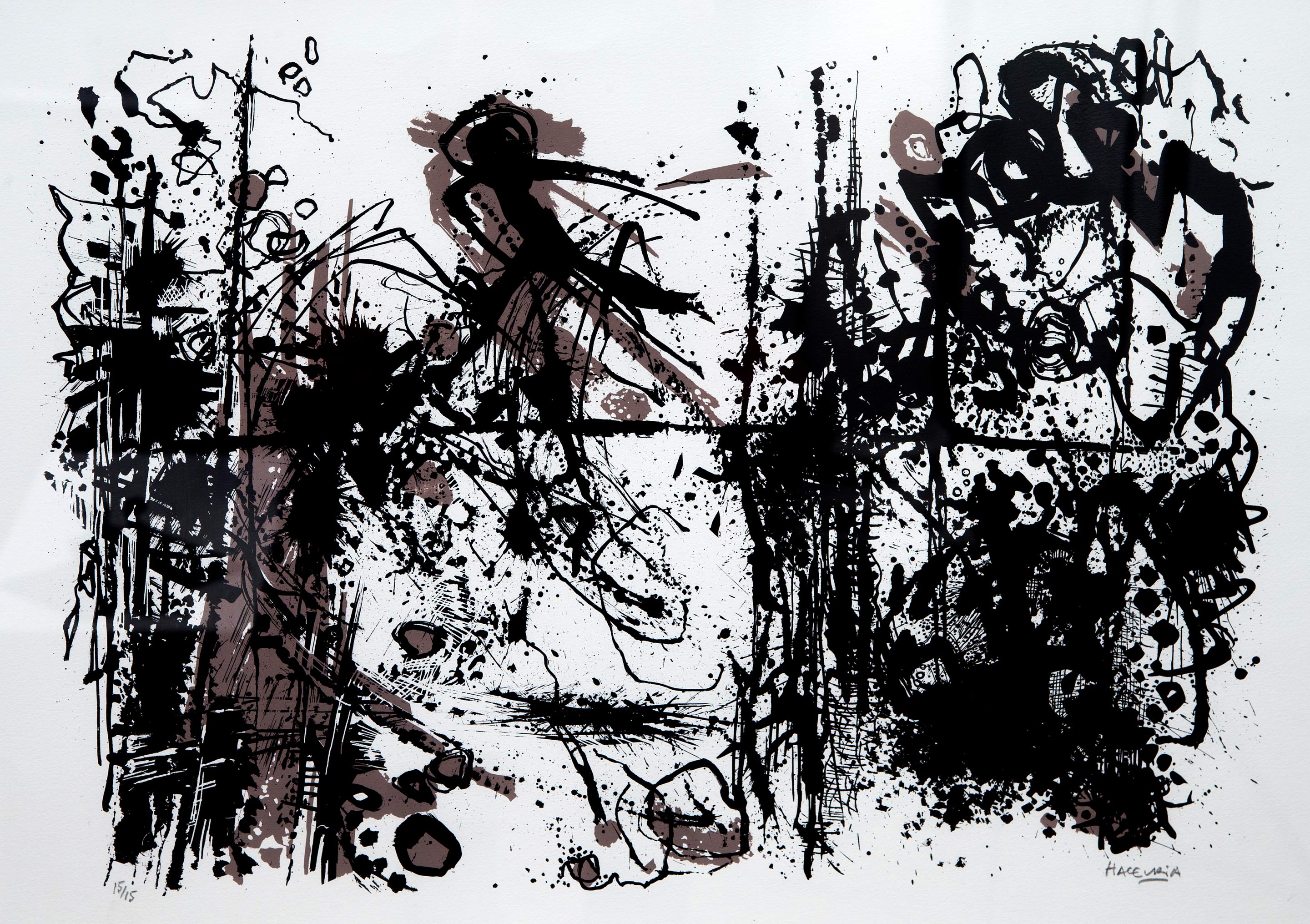
Maurice Haccuria gives a new impulse to his graphic oeuvre: lively imagination and spontaneity in pure black and white.
Distinguished in the third Olivetti Prize for painting (Palace of Fine Arts, Brussels).
1967
Carries out integration commissions: a large iron relief for the facade of the Administrative Centre in Hasselt and a monumental stained-glass window for the chapel at the Woluwedal in Woluwe-Saint-Lambert.
1969
Illustrates “Maran Atha”, poems by Mark Dangin.
1970
The exorcism of fate. Maurice Haccuria returns to the Aarschot area and settles at the Heikant in Rotselaar. Draws breath, revives.
1972
Bronze medal at the 11th International Biennale of Xylography in Capri.
1973
Laureate of the Hembecca Prize for Graphic Art (Cultural Centre, Brussels)
1974
Bids farewell to teaching.
1976
Paints, makes screen prints and linocuts. His creativity reaches new horizons: he uses enormous tree trunks for his sculptures and discovers the Mecca of sculptors, Carrara.
1977
Becomes a member of the Belgian Council for Visual Arts. Exhibits his marble sculptures in our country for the first time.
Until 1988 goes to Carrara every year to work in marble there.
1988-89
Paints. Carves sculptures from bluestone and from the last marble blocks brought back from Carrara.
1990-91
Wages a hopeless battle against the illness that afflicts him.
Paints. Makes his last little figures in bronze, his last lino-cuts.
HACCURIA PRIZES:
- Young Belgian Painting – Brussels – 1957 and 1958
- Talens Prize for Belgium – Brussels 1959
- Swiss Prize for Abstract Painting – Lausanne 1961
- Europe Prize for Painting – Ostend 1962
- Prize of the Belgian Art Critics – Charleroi 1962
- Olivetti Prize for Sculpture – Brussels 1963
- Laureate Hembecca Prize for Graphic Art – Brussels 1973
- Bronze medal of the International RHO Prize – Milan 1985
- Silver medal at the international competition in Seoul – South Korea 1985
HACCURIA COLLECTIONS:
- The Belgian State
- The Print Room of the Royal Library, Brussels
- The Art Heritage of the Province of Brabant
- The Art Foundation Rotterdam
- The Municipal Print Room, Antwerp
- The Middelheim Museum, Antwerp
- The Ministry of Dutch and French Culture, Brussels
- The World Print Council San Francisco
- The Modern Museum, Brussels
- The museums of Capri, Macerata, San Francisco, Skopje, Antwerp and Brussels
SOURCE:
- Publication on the occasion of the Haccuria exhibition – C.C. Het Gasthuis Aarschot 1997.
- Publication on the occasion of the Haccuria exhibition – C.C. Het Gasthuis Aarschot 2019.
BELGIAN PAINTERS IN THE 19TH & 20TH CENTURIES:
Haccuria, Maurice(Jeuk (Goyer), 1919 – Leuven, 1991) Painter, sculptor, graphic artist, self-taught. Painted animistic landscapes in 1943. Absorbed Expressionism and Cubism and around 1960 ended up in a lyrical abstraction closely related to action painting and Cobra’s formal language.Also worked monochrome for some time, but from the end of the 1960s the palette became more colourful again.From the press: “The work of Maurice Haccuria is at once, on the one hand, analytical, unravelling, reducing nature to a few elementary graphic components, and on the other hand intuitive, guessing at the meaning of life and nature, of man and his way of existing”. Also made his debut in sculpture in 1959.On his sculpture:“He succeeds in freeing from the unwieldy mass a structure that excels through its calm elegance. In his compositions, intellectual creation appears to win out over imagination, although feeling is seldom absent.”Prize of Young Belgian Painting in 1957 and 1958. Was a teacher at the Academy in Aarschot. Work among others in the Print Room in Brussels, in the Middelheim in Antwerp. Mentioned in BAS 1
Paul Piron
PERSONAL IMPRESSIONS:
After the kinship with the mythological motifs of ancient civilisations, to which Haccuria’s first sculptures point, he appears in the meantime to have partly shifted his themes. A bronze sculpture such as “The Ruler” proves this: in it one can recognise a sort of warrior, and the artist clearly strikes out in a new direction.
A renewal is also announced in the paintings. In “Rainy Day”, a particularly rich work in which white and black are central, all kinds of colours slide away behind the central part only to emerge again in full force further out, at the edge of the painting. Luminosity plays an important role in his most recent works.
W.M. Roggeman – 1974
Between the barbarity of action painting and the cerebral quality of the cold abstract artists, Haccuria has found his way of working, his liberation, his discharge. His art is not limited to painting the object, but is rather a working-up of a series of feelings into condensed, explosive moments.
Jaak Baert – 1976
Haccuria has managed to transform the temperamental achievements, and also the carelessness, of COBRA into a deliberate, controlled and condensed hand, from which the fortuitous, improvised and impulsive gesture has completely disappeared, replaced by the certainty and naturalness of gesture and colour.
Roger De Neef – 1977
Maurice Haccuria, as a self-taught artist you began the demanding struggle for your own art. To be self-taught means to go one’s way powerfully in solitude, from one’s own drive, from wonder and admiration, from a hesitant presentiment. This is the solitude of those who see more sharply and feel more deeply, the solitude of those who dare to experience their own feelings purely and to build their vision from personal investigation. This is also the solitude of those who know no compromises and love simplicity, directness of expression, without frills. That solitude has now “finally” become rich mildness out of the calm knowing, the knowing of the wise. Your dream has become tangible reality.
Fons Verstreken – 1997
I got to know Maurice Haccuria in 1974 at the academy in Aarschot, where he had charge of the painting – monumental art studio.
He came across as a calm, somewhat thoughtful man who, with his international experience as a visual artist, brought a whole generation of artistically motivated people from Aarschot and the region into contact with, and made them aware of, current developments in art. In this way he opened for many young artists the door to new artistic possibilities, to experimenting with matter and space, and gave the Aarschot academy a new dimension.
Ben Cloots – 1997
MAURICE HACCURIA 25 YEARS OF PRINTS :
Passionate about all forms of expression, Maurice Haccuria is a painter, sculptor and printmaker. He is the author of a range of creations that cannot leave one indifferent, and his printed work in particular, which has spread over a period of twenty-five years, reveals several facets of his artistic personality. One detects in it a boundless imagination and fantasy, a light and quick mind, a very virile freedom in execution.
Maurice Haccuria was born in 1919. A self-taught artist, he draws us into a world that, from the very start (1950), is very personal to him, a figuration of things and beings already imbued with great aesthetics. The technique he uses – wood or lino – is certainly not one of the most appreciated outside connoisseurs, but this material allows him to convey, through the play of shadows and lights, everything he feels.
It is from 1953 to 1958, through book illustration, that the artist gradually discovers this world suggested by wood, which holds all his attention.
From “Hiroshima” (1954) to the “Four Seasons” (1981), what a path travelled! And yet Haccuria has always remained himself. Over the years, in addition to the natural gifts he possesses, he has acquired great manual skill. He has understood and discovered the expression of an instinctive art. At first sight one has the feeling of easy work. But this ease is in reality offset by the thorough knowledge of a craft that tolerates no second thoughts. The engraver cannot afford any detour to reach his goal. The lines must be precise in order to represent forms and contours. The framing is powerfully articulated, the accessories are limited to the essential, the setting is indicated to a minimum. By simplifying their vision, he incorporates them into the overall composition. The deformation imposed on the figures aims to exalt their character and to draw out their quintessence: thereby gaining in power, it comes close to caricatural intent. His bold juxtapositions of unsoftened black and white zones constitute the engraver’s style. And this style is particularly well suited to the technique of woodcut and linocut. It helps to bring out the constructive virtues of the outline and, through the decorative element, reinforces the balance of the subject.
He simplifies and strongly incises the lines, the movement, which brings out the contours; he relies on the simple value of contrasts, there are no half-tones. Occasionally, the jagged incision of an inner contour gives a shadow effect.
It is in a somewhat fantastical journey, through his vision of forms, that he seeks and finds the power of volumes. He uses constructions to accentuate straight lines. He draws us into a beyond, into a reverie, where everyone can withdraw into themselves. He dominates and orders the interiority of feelings, while catching the eye.
Monique Marechal– 1981